GizmoBench guides
Calorie Burn Estimation: How to Work Out What You Burn

You can estimate calories burned with one formula: kilocalories = MET value × body weight in kilograms × duration in hours. A MET (metabolic equivalent of task) is a multiple of the energy you use sitting quietly, so a 4-MET activity costs about four times your resting rate. The result is an estimate for a typical adult, not a measurement of you, and the most useful way to track it is to use the same method every time and watch the trend. This guide shows the arithmetic, a worked example, the resting baseline, how steps fit in and how far to trust trackers.
TL;DR
- Activity calories ≈ MET × weight (kg) × hours. For example, a 70 kg person sweeping at 3.8 METs for 30 minutes uses about 133 kcal, according to the Compendium of Physical Activities.
- Resting energy expenditure is usually the largest share of daily burn, roughly 60 to 70% of the total, so the activity part is the smaller number.
- Treat every figure as an approximation. MET tables describe populations, and individual results vary with body size, fitness and the exact movement.
- For tracking, pick one method (formula, watch or app), keep your weight and units consistent, and compare weeks rather than single workouts.
Table of Contents
- What “calories burned” is made of
- The MET formula, step by step
- What the intensity categories mean
- Estimating what you burn just by existing
- Everyday movement counts too
- Steps and calories: can 10,000 steps burn 400?
- How accurate are calculators and trackers?
- A simple routine for tracking calories burned
- Where GizmoBench fits
- FAQ
- Sources
What “calories burned” is made of
The National Academies’ 2023 Dietary Reference Intakes report splits total daily energy expenditure into three parts: resting energy expenditure, the thermic effect of food (the energy used to digest and process what you eat), and physical activity. The same report states that resting expenditure typically accounts for 60 to 70% of the total and varies with age, sex, body size and composition, and genetics.
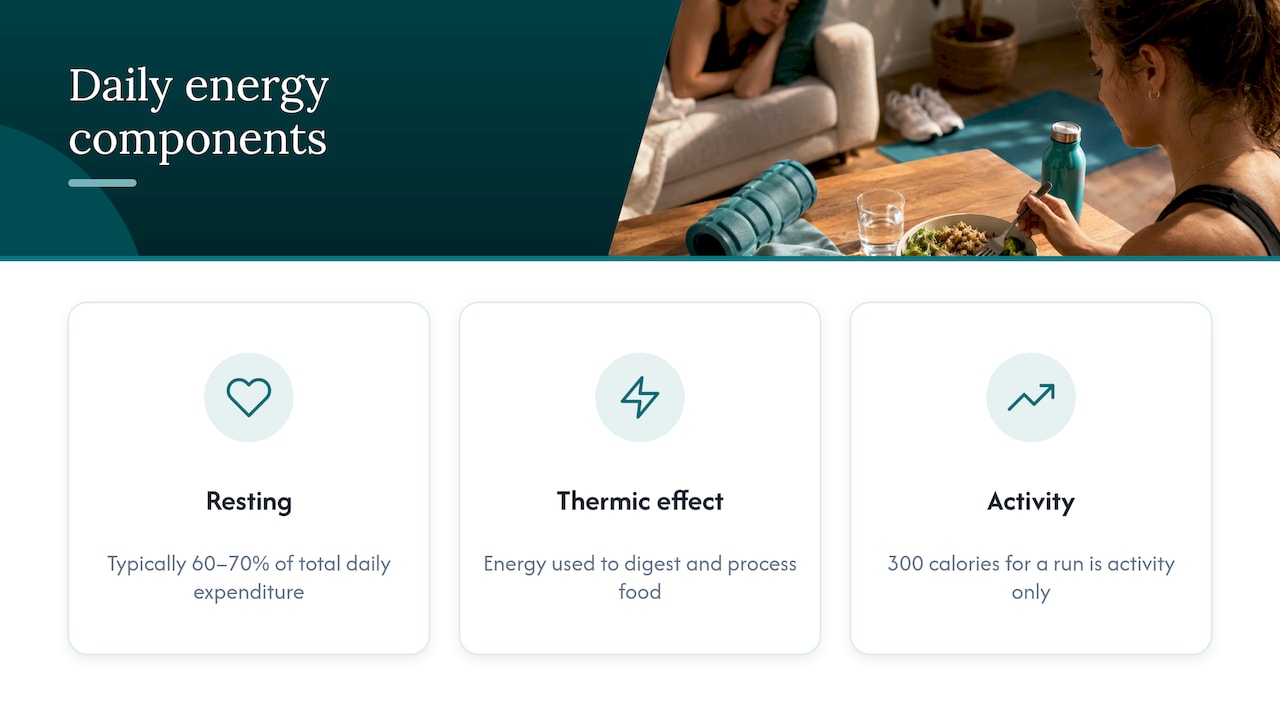
This matters for how you read a number. When a calculator reports 300 calories for a run, that is only the activity slice. It is not your whole day, and it is not the same as your total daily energy expenditure (TDEE). Mixing the two is the most common reason estimates feel inconsistent.
A note on units: the “calories” on food labels and fitness screens are kilocalories (kcal), each equal to 1,000 small calories. If a source or tool mixes the two, our kcal to calories converter shows the relationship.
The MET formula, step by step
Most online calorie-burn calculators use the same method. The Compendium of Physical Activities gives it as kilocalories = MET × weight in kilograms × duration in hours. Here is how to apply it.
- Find the MET value for your activity. The 2024 Adult Compendium of Physical Activities lists 1,114 activities, with measured MET values for 912 of them and estimated values for 202. Search for the closest match to what you did, and note whether the entry is measured or estimated.
- Convert your weight to kilograms. One pound is 0.45359237 kg, so 180 lb is about 81.6 kg. The Unit Converter handles mass conversions in the browser, which avoids rounding slips when you do this by hand.
- Convert the duration to hours. Forty-five minutes is 0.75 hours, and 20 minutes is about 0.33. Dividing minutes by 60 is the usual place for errors, such as typing 1.30 for an hour and a half.
- Multiply the three numbers. The product is kilocalories for that session.
A worked example
The Compendium’s own example is a 70 kg person sweeping at 3.8 METs for 30 minutes: 3.8 × 70 × 0.5 = 133 kcal.
Here is a second example with an assumed value. Suppose you weigh 180 lb (81.6 kg) and do an activity you have matched to 5.0 METs for 45 minutes. The 5.0 is an illustrative assumption, not a looked-up value for a specific activity.
- Weight: 180 lb × 0.45359237 = 81.6 kg
- Duration: 45 ÷ 60 = 0.75 hours
- Calories: 5.0 × 81.6 × 0.75 ≈ 306 kcal
If you instead typed 180 as the weight, you would get 675 kcal, more than double the correct figure. Unit mix-ups are the biggest avoidable error in this method.
What the intensity categories mean
The CDC’s intensity guide defines one MET as the energy used while sitting quietly. It treats 3 to 5.9 METs as moderate and 6 or more as vigorous in absolute terms. The 2024 Compendium uses a slightly finer scale:
| Category | MET range |
|---|---|
| Sedentary behavior | 1.0 to 1.5 |
| Light activity | 1.6 to 2.9 |
| Moderate activity | 3.0 to 5.9 |
| Vigorous activity | 6.0 or more |
The CDC also notes that intensity is relative to fitness: something vigorous for an average-fit person may be moderate for a very fit one. A MET value is fixed in the table, but how hard the activity feels is not, which is one reason a table value can sit apart from your experience.
The Compendium is intended for adults aged 19 to 59 without disabilities or significant conditions affecting energy expenditure. If that does not describe you, the figures are a rougher guide, and a physician or registered dietitian is the right person to ask about energy needs.
Estimating what you burn just by existing
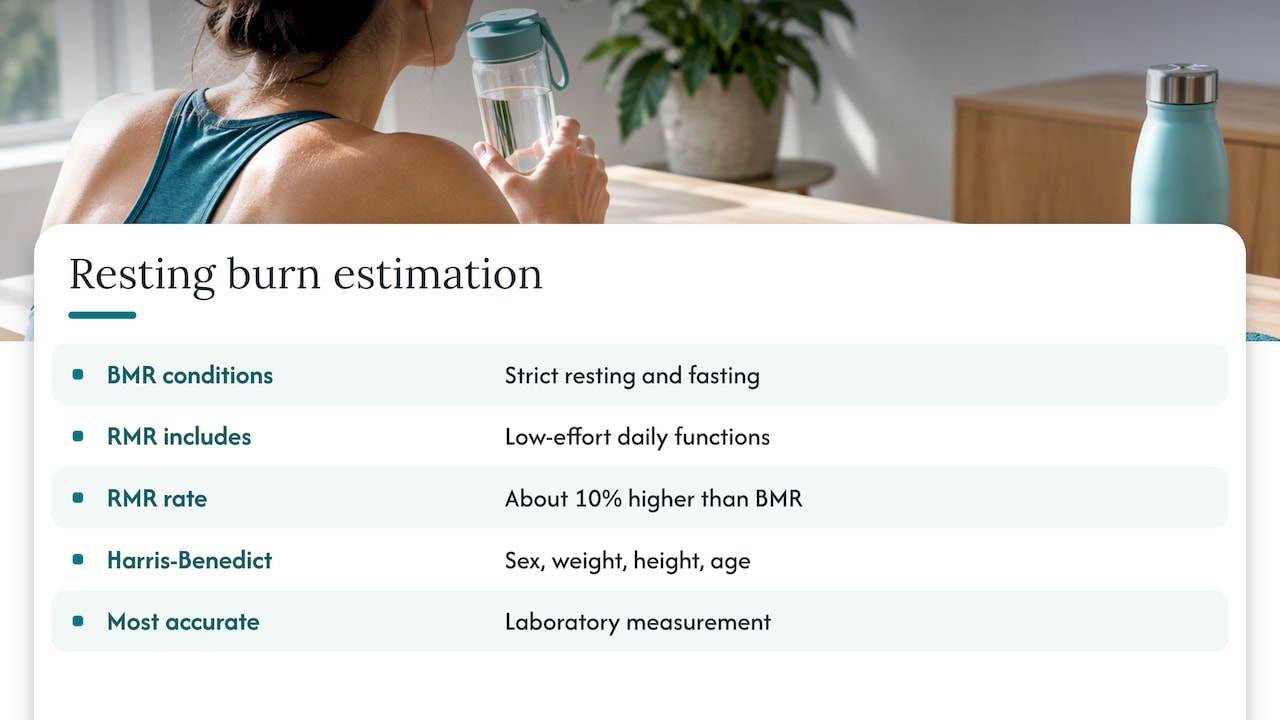
Because resting expenditure is the biggest share, a baseline estimate is worth having. The Cleveland Clinic explains that basal metabolic rate (BMR) is measured under strict resting and fasting conditions, while resting metabolic rate (RMR) includes low-effort daily functions and runs about 10% higher. It describes the Harris-Benedict equation, which uses sex, weight, height and age, as a way to estimate BMR, with laboratory measurement being the most accurate route.
Our BMR formula guide walks through the equations with worked examples and shows how BMR becomes TDEE. If your goal is to compare intake against output, the calorie deficit formula article covers the next step, and the macros guide turns a calorie target into grams.
For body composition, which influences resting burn, the body fat calculator offers a tape-measure method alongside BMI.
Everyday movement counts too
Workouts are not the only source of activity calories. A UT MD Anderson guide points out that cooking, cleaning, vacuuming and climbing stairs all contribute to energy expenditure. The MET method covers them as well: the sweeping example above is a household task.
The MRC Measurement Toolkit describes total expenditure over a period as the product of activity intensity, duration and frequency. In practice, that gives you a simple way to build a day: list each activity, calculate it separately, and add the results. A short list might look like this:
- 30 minutes of household chores, at the MET value you match to them
- 20 minutes of brisk walking
- A 45-minute workout
Each line uses the same formula. The sum is your estimated activity energy for the day, to be added to your resting estimate if you want a total.
Steps and calories: can 10,000 steps burn 400?
It is a common question, and the answer depends on body size and pace. A Men’s Health piece says an average-sized man of roughly 200 lb might burn around 400 to 500 calories over 10,000 steps accumulated through normal daily activity. A Ro article gives a similar 400 to 500 range for most adults and stresses that weight, pace and terrain change the result.
A Verywell Health chart shows how much weight alone moves the figure: at 2 mph, estimated burn is 2.9 calories per minute for people weighing 125 to 174 lb and 4.0 calories per minute for those weighing 175 to 250 lb.
So 400 is plausible for some people and high for others. If you only know your distance, the miles to steps calculator converts between the two, and you can then estimate time at your pace and use the MET formula for walking.
How accurate are calculators and trackers?
The honest answer is that they are approximations, and the research says so directly. The 2024 Compendium authors caution that standard METs are a useful starting point for classifying activities but do not give precise individual values, because resting metabolism and activity costs vary between people. They also note that MET tables were developed mainly to make activity estimates comparable across studies, so they are population-level approximations.
For wearables, a 2020 systematic review in the British Journal of Sports Medicine found that accuracy varies by activity. Research-grade devices were more accurate for total energy expenditure, though not for every activity. The MRC Measurement Toolkit explains why: accelerometers do not measure energy directly. Models infer it from movement, and that relationship shifts with where the device sits on the body and what activity is performed. Heart-rate devices sometimes did better than accelerometer-only models, but not consistently.
Resistance training is a particular case. A 2024 scoping review of 166 studies found wide variation in reported energy expenditure. It also noted that MET values may be more practical than laboratory equipment outside a lab.
What this means for you:
- Use a figure as a range (for example, 280 to 340 kcal), not a single exact value.
- Expect the same device or formula to be consistently high or low for you, which is fine if you keep using it.
- Do not subtract or add a workout figure to your food intake as though it were exact.
A simple routine for tracking calories burned
Tracking works best when the method stays fixed, because then changes in the number reflect changes in what you did.
- Choose one source of estimates. Either the MET formula, a watch or an app. Switching between them mid-week makes comparisons meaningless.
- Record the inputs, not just the result. Write down activity, minutes and your weight in kilograms. If you later correct a MET value, you can recalculate.
- Log activity calories separately from resting calories. Active calories are the energy of movement above rest, and total calories include your resting burn. Check which one your device displays.
- Update your weight occasionally. The UT MD Anderson guide notes that the more a person weighs, the more calories they generally burn doing the same activity, so a stale weight skews the formula.
- Review weekly. Add up seven days and compare with the previous week. Single-day noise averages out.
If you track intake as well, keep in mind that both sides carry error. A modest gap between the two, observed over several weeks, tells you more than any one day.
Where GizmoBench fits
GizmoBench is a collection of browser-based tools that run without an account or installation, and file processing happens locally in the browser. For this task, the Unit Converter covers the weight and unit conversions the formula needs, and the everyday tools page lists the percentage and other calculators that help with the surrounding arithmetic. The BMR formula guide and the best calorie calculator article cover the resting and total-calorie side.
FAQ
How do I estimate calories burned without a device?
Multiply the MET value of your activity by your weight in kilograms and by the time in hours. A 70 kg person doing a 3.8-MET task for half an hour comes out at 133 kcal. Look up the MET value in the Compendium of Physical Activities and treat the answer as an estimate.
Can 10,000 steps burn 400 calories?
For some people, yes. Published estimates put it at roughly 400 to 500 calories for many adults, with heavier people at the higher end and lighter people lower. Pace and terrain also change the result.
What is the difference between active calories and total calories?
Active calories are the energy spent on movement. Total calories add your resting energy expenditure, which the National Academies report says is typically 60 to 70% of the total. Check which figure your tracker or calculator is showing before you compare numbers.
How many calories do I burn at rest?
You can estimate basal metabolic rate with the Harris-Benedict equation, which uses sex, weight, height and age. Measuring it precisely requires laboratory conditions. Our BMR formula guide shows worked examples.
Are fitness trackers more accurate than the formula?
Not necessarily. Research finds that wearable accuracy depends on the device and the activity, and the MET formula is a population-level approximation. Either can be useful for tracking your own trend if you stay consistent.
Sources
- 2011 Compendium of Physical Activities: A Second Update, Medicine & Science in Sports & Exercise
- 2024 Adult Compendium of Physical Activities: A third update
- CDC: How to Measure Physical Activity Intensity
- National Academies: Factors Affecting Energy Expenditure and Requirements
- Cleveland Clinic: BMR (Basal Metabolic Rate)
- UT MD Anderson: How to determine calorie burn
- MRC Measurement Toolkit: Energy expenditure
- MRC Measurement Toolkit: Accelerometers
- British Journal of Sports Medicine: How well do activity monitors estimate energy expenditure?
- Methods to Assess Energy Expenditure of Resistance Exercise
- Men’s Health: Walking 10,000 Steps Burns More Calories Than You Think
- Verywell Health: How Many Calories Do You Burn Walking 10,000 Steps?
- Ro: How Many Steps a Day to Lose Weight?