GizmoBench guides
Circle Circumference Formula: Quick Answer, Exact in π and 3 Examples
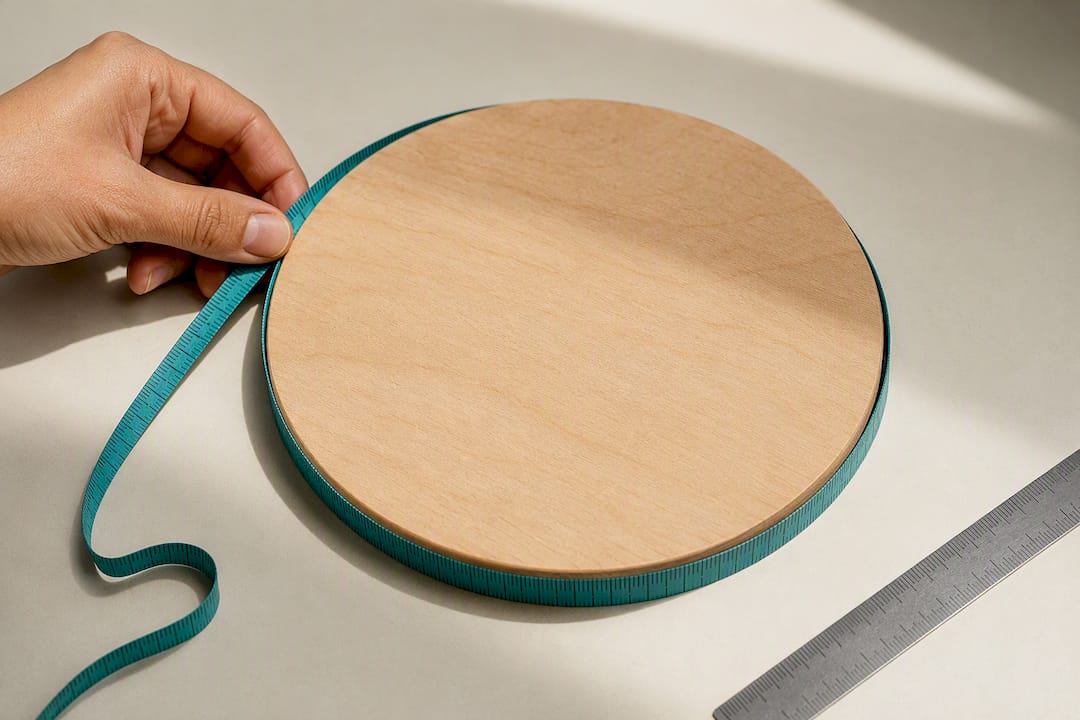
The circumference C of a circle equals π times the diameter, or C = π·d. If you know the radius instead, use C = 2·π·r. Both formulas give identical results, since a diameter is just twice the radius, so pick whichever value you already have and plug it straight in.
TL;DR:
- Students should always verify whether a problem provides the radius or the diameter before applying circumference formulas, as mixing them causes errors.
- Rounding errors can significantly affect the accuracy of the circumference, especially with larger radii or multiple calculation steps, so rounding should only happen at the final stage.
- Using 3.14 or 22/7 for π provides quick estimates but introduces small inaccuracies; calculator π offers the most precise decimal for exact applications.
- Converting units before calculating is essential; mixing incompatible units like inches and feet without conversion leads to incorrect circumference results.
- The exact circumference of a circle with a 20-inch diameter is 20π, approximately 62.83 inches, and should be used in precise calculations to avoid cumulative errors.
Table of Contents
- Understanding the Circle Circumference Formula
- Worked Examples: Finding Circumference Step by Step
- Should You Use 3.14, 22/7, or Calculator Pi?
- How Does the Unit Circle Connect to Circumference?
- Practice and Check Your Work With GizmoBench
- Sources
- FAQ
Understanding the Circle Circumference Formula
Circumference is the distance around a circle, the same idea as perimeter for a square or rectangle, just applied to a curved boundary. Every circle, no matter how big or small, shares one fixed relationship: divide its circumference by its diameter and you always get the same number, roughly 3.14159/07%3A_Geometry/7.02%3A_Perimeter_Circumference_and_Area/7.2.03%3A_Circles). That constant is π, and it’s the reason the two circumference formulas exist in the first place: π is literally defined as C/d.
Because a diameter is twice the length of a radius (d = 2r), the two formulas are really the same equation written two ways:
- Start with C = π·d
- Substitute d = 2r
- That gives C = π·(2r), which simplifies to C = 2·π·r
Neither version is more “correct.” You use C = π·d when a problem hands you the diameter, and C = 2·π·r when it gives you the radius. Trying to force the wrong value into the wrong formula is the single most common error students make, and it’s worth double checking which one you were given before you multiply anything.
One more habit worth building early: leave your answer as a multiple of π (like 20π) when the problem calls for an exact answer, and only convert to a decimal when you need a number you can actually measure with a ruler or tape. The Mathwords reference on circumference treats both the exact π-form and the decimal approximation as standard ways to express the same result.
Worked Examples: Finding Circumference Step by Step
Numbers make this stick faster than any explanation. Here are three examples that cover the situations you’re most likely to see on a worksheet or exam.
- Diameter = 20 inches. Using C = π·d, that’s C = 20π. Multiplying by π ≈ 3.14159 gives C ≈ 62.83 inches. This is the classic textbook example, and it shows up almost verbatim in the Mathwords circumference reference, which confirms 20π ≈ 62.83 in.
- Radius = 2.5 yards. Using C = 2·π·r, that’s C = 2 × π × 2.5 = 5π, which is equal to 5 times π in exact form. Converting this to a decimal involves approximating π, which gives a value near 15.71 yards. For unit consistency, convert units before multiplying.
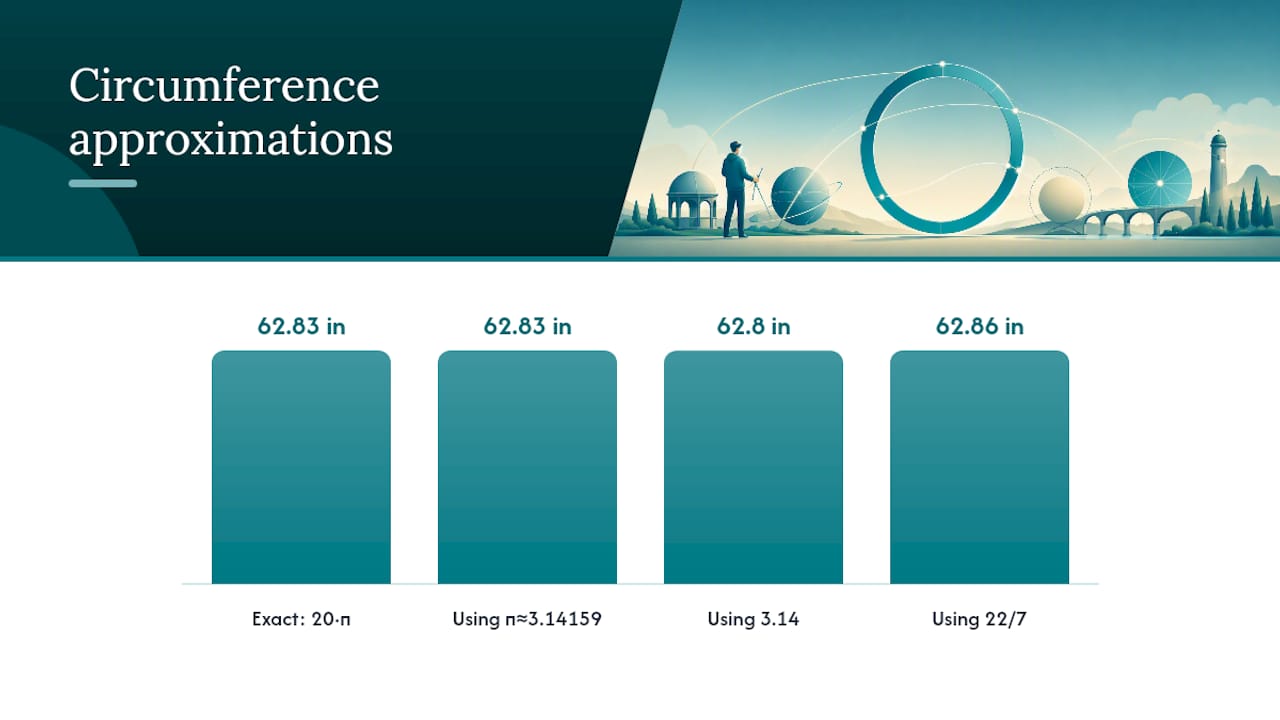
- Same 20-inch diameter, two approximations. Using 3.14, C ≈ 62.8 inches. Using the fraction 22/7, C is about 62.86 inches. The true circumference value is exactly 20π, which is approximately 62.83 inches.
Pro Tip: Round only at the final step. If you round π early and then keep multiplying, small errors stack up fast, especially on problems with large radii or multiple steps.
That third example is worth sitting with for a second: 3.14 undershoots the true circumference slightly, while 22/7 overshoots it. Neither is wrong for quick estimates, but neither is exact either, since π’s decimal expansion never terminates or repeats.
Should You Use 3.14, 22/7, or Calculator Pi?
The honest answer: it depends on what the answer is for. If a problem says “leave your answer in terms of π,” write 20π and stop. That’s the exact value, with zero rounding error. If it asks for a decimal, that’s when you choose an approximation, and the one you choose changes your precision.
- 3.14 is fine for quick estimates and most middle school work, but it introduces small rounding error.
- 22/7 approximates π reasonably well and is common in classroom shortcuts, though it actually overshoots π by a slightly larger margin than 3.14 undershoots it.
- Calculator or device π (the π button, not a typed approximation) carries far more decimal places and is the better choice whenever precision matters, since π is a transcendental number with an infinite, nonrepeating decimal expansion.
Units matter just as much as which π you pick. Before you multiply, make sure your radius or diameter is in a single consistent unit, inches, feet, yards, centimeters, or meters. If a problem gives you a radius in inches but asks for circumference in feet, convert first, then compute. Mixing units mid-calculation is the second most common way students get circumference problems wrong, right behind confusing radius and diameter.
How Does the Unit Circle Connect to Circumference?
Here’s a preview of where circumference leads once you move from geometry into trigonometry. A unit circle has a radius of exactly 1, so its circumference works out to C = 2·π·(1) = 2π. That single fact is why you’ll see 2π everywhere once trig angles enter the picture, since a full turn around any circle, scaled to radius 1, always measures 2π units.
- Arc length follows the formula s = r·θ, where θ is the angle in radians.
- On a unit circle, r = 1, so the formula simplifies to s = θ. The arc length and the angle in radians become the same number.
- This is the core idea behind how the unit circle defines sine and cosine: angles are measured as distances along the circumference itself, not degrees.
You don’t need any of this to answer a straightforward circumference problem. But if you’re heading toward trigonometry, understanding that radians are just arc lengths on a circle of radius 1 makes the whole unit circle a lot less like something to memorize and a lot more like something that follows logically from what you already know about circumference.
Practice and Check Your Work With GizmoBench
Working through circumference problems by hand builds the intuition, but checking your answer against a tool saves you from carrying a small arithmetic slip through an entire assignment. The area calculator covers circles alongside other shapes, shows the formula it’s applying, and gives you both the exact π-form result and the decimal output side by side, so you can see exactly how your radius or diameter translates into a final number. It runs directly in your browser, with no account needed and nothing to install.
If a problem asks you to compare the C/d ratio across different circles, the ratio calculator simplifies that comparison in a couple of clicks. And once your decimal answer comes out to a long string of digits, the rounding calculator handles rounding to a specific number of decimal places cleanly, which is useful when a worksheet asks for an answer “rounded to the nearest hundredth.” None of this replaces doing the math yourself. Such tools are useful for a second opinion before you turn in a problem set.

Sources
For a formal definition of circumference and its relationship to arc length, Wikipedia’s circumference entry is a solid starting point. Students who want a textbook-style walkthrough with practice problems should check the LibreTexts geometry chapter on circles. For extra practice sets on radius, diameter, and circumference, Khan Academy’s lessons are built specifically for that kind of repetition. If you need standardized numeric approximations for applied or technical work, NIST’s circumference and area reference lists practical conversion values.
FAQ
Is the circumference 3.14 times the diameter?
Approximately, yes. Using 3.14 for π gives a close estimate, but the exact relationship is C = π·d, and π’s true value carries far more decimal places than 3.14 captures.
What does 2πr represent for a circle?
2πr is the circumference formula written in terms of radius rather than diameter. It gives the exact same result as π·d, since the diameter is always twice the radius.
Are there two formulas for circumference?
Yes, C = π·d and C = 2·π·r are the two standard forms, and they’re mathematically identical because d = 2r. Use whichever formula matches the value your problem already gives you.
What is the circumference of a 20-inch diameter circle?
Using C = π·d, a 20-inch diameter gives C = 20π, which equals approximately 62.83 inches when rounded to two decimal places.