GizmoBench guides
1–1000 Roman Numerals Chart for Classrooms: Scannable Blocks, Free Converter

This page carries a complete Roman numerals chart covering 1 through 1000, organized into several scannable blocks. The system runs on seven symbols: I, V, X, L, C, D, and M. If you need a quick answer for a specific number rather than the full pattern, GizmoBench’s Roman numeral converter handles either direction instantly, no account required.
TL;DR:
- The seven symbols I, V, X, L, C, D, and M form the entire Roman numeral system, combining through addition and subtraction rules to create numbers up to 1000.
- Subtractive notation uses only six valid pairs: IV, IX, XL, XC, CD, and CM, with no other combinations like IL or IC considered standard.
- Roman numerals never include more than three repeated symbols in a row, except on clock faces, where IIII is used instead of IV for visual balance.
- Converting numbers involves breaking them into thousands, hundreds, tens, and units, then applying rules to each section and concatenating for the final numeral.
- GizmoBench’s free online converter allows instant verification of hand conversions, saving time and reducing errors in learning or practicing Roman numerals.
Table of Contents
- Roman Numerals Chart From 1 to 1000
- How Are Roman Numerals Formed?
- Why Do Some Clocks Show IIII Instead of IV?
- Where Do Roman Numerals Show Up Today?
- How Do I Convert a Number to Roman Numerals?
- Printable Chart and Practice Worksheets
- The GizmoBench Roman Numeral Converter
- Sources
- FAQ
Roman Numerals Chart From 1 to 1000
Seven letters carry the entire system.
| Symbol | Value |
|---|---|
| I | 1 |
| V | 5 |
| X | 10 |
| L | 50 |
| C | 100 |
| D | 500 |
| M | 1,000 |
That’s the whole alphabet of the system. Every other numeral, no matter how long, is formed from these seven letters arranged in combinations. Britannica’s overview of the Roman numeral system confirms these are the only base symbols in standard use, and everything else is derived from them through addition or subtraction.
Educational references, including BYJU’S 1 to 1000 chart, typically split the full range into blocks of 100 or so, because scanning a single 1,000-row list is exhausting and pattern recognition works better in chunks. The four tables below follow that same logic, moving from the simplest range into the ranges where the subtractive rules for hundreds and thousands start to matter.
Numbers 1 to 100
The first hundred numbers teach almost every rule you’ll ever need. Notice how the pattern resets every ten: I, II, III, IV, V, VI, VII, VIII, IX, X, then the whole cycle repeats with an X in front.
Look at 44 (XLIV) closely. It’s XL (40) plus IV (4), two subtractive pairs stacked next to each other. That’s a common trip-up point for beginners: you’re not subtracting 4 from 50, you’re combining two separate operations, each following its own rule.
Numbers 101 to 400
This range is where the hundreds column starts stacking. C repeats up to three times (CCC = 300), then the subtractive rule kicks in for 400.
CD for 400 trips up more students than almost any other pair in the chart. It reads as “100 before 500,” meaning 500 minus 100. Writing CCCC instead is one of the most common errors learners make, since it seems logical to just keep adding C’s the way you did up through 300.
Numbers 401 to 800
Once you pass 500, the pattern flips back to additive for a while. D stands alone at 500, then C’s pile on again up to DCCC for 800.
DCCC for 800 is the longest run of repeated additive symbols you’ll see in this whole range: D plus three C’s. It’s a good test case for the “no more than three in a row” rule, since C appears exactly three times and stops there.
Numbers 801 to 1000
The final stretch brings back a subtractive pair (CM for 900) before landing on the single-letter M for 1000, the cleanest number in the entire chart.
| Number | Roman Numeral | Number | Roman Numeral |
|---|---|---|---|
| 801 | DCCCI | 950 | CML |
| 850 | DCCCL | 975 | CMLXXV |
| 899 | DCCCXCIX | 990 | CMXC |
| 900 | CM | 999 | CMXCIX |
| 925 | CMXXV | 1000 | M |
CMXCIX (999) is often cited as the longest common numeral in this range: three subtractive pairs back to back (CM, XC, IX), each doing its own job. Once you can read that one confidently, you’ve essentially mastered the system up to 1,000.
How Are Roman Numerals Formed?
Two rules govern everything in this chart: addition and subtraction. Get comfortable with both, and you can build or read any numeral up to 1,000 without memorizing a single extra chart entry.

The additive rule says that when a symbol appears after one of equal or greater value, you add it. VI is V (5) plus I (1), which equals 6. LXX is L (50) plus X (10) plus X (10), which equals 70. Read left to right, largest to smallest, and add as you go.
The subtractive rule kicks in when a smaller symbol sits directly before a larger one. In that case, you subtract the smaller from the larger instead of adding. According to Britannica’s rules for the system, only six pairs are valid in standard notation:
- IV = 4 (5 minus 1)
- IX = 9 (10 minus 1)
- XL = 40 (50 minus 10)
- XC = 90 (100 minus 10)
- CD = 400 (500 minus 100)
- CM = 900 (1,000 minus 100)
No other subtractive combination is standard. You’ll never legitimately see IL for 49 or IC for 99; those get built from XLIX and XCIX instead, using the tens-place subtraction first.
One more constraint shapes every numeral on this chart: standard notation avoids stacking more than three identical symbols in a row. III (3) is fine, but IIII for 4 breaks the rule in modern practice, which is exactly why IV exists. The same logic caps X, C, and M at three repeats each. (Clock faces are the famous exception, covered in the next section.)
Converting a plain number into Roman numerals follows a short, repeatable process:
- Break the number into thousands, hundreds, tens, and ones.
- Convert each place value separately using the additive and subtractive symbols for that range.
- Check each converted chunk against the “no more than three repeats” rule.
- String the four converted chunks together, largest place value first.
- Re-read the finished numeral left to right to confirm it decodes back to your original number.
That five-step loop is the same one behind every table above, and it’s the one worth memorizing if you’re building numerals by hand instead of just looking them up.
Why Do Some Clocks Show IIII Instead of IV?
Standard Roman numeral notation caps repeated symbols at three, which is why IV represents 4 almost everywhere you look. Clock faces are the well-known exception. Many analog clocks and watches use IIII instead, and the reason is more practical than mathematical.
A few explanations show up consistently in historical accounts of clockmaking, and the Wikipedia entry on Roman numerals covers the visual and traditional reasoning behind the choice:
- IIII creates better visual balance opposite VIII on a clock face, since both use four symbols.
- Some clockmakers reportedly preferred IIII for symmetry with the four-symbol numerals on the other side of the dial.
- The convention became traditional in clock manufacturing and simply persisted, independent of the “official” written standard.
Two other historical notations show up if you ever read primary-source transcriptions or older inscriptions. A vinculum, a horizontal bar drawn over a numeral, multiplies that numeral’s value by 1,000. A bar over V (V with a line on top) represents 5,000, not 5. The apostrophus, an older system using reversed C-shaped marks, was another way ancient scribes represented large numbers before the modern letter-based system fully standardized. Both appear rarely in elementary instruction but show up often enough in historical documents and academic transcriptions that it helps to recognize them on sight.
Pro Tip: If a worksheet or exam ever asks you to “read” a numeral from a clock or an old inscription rather than “write” one, expect a variant like IIII. Standard-form rules apply when you’re building numerals yourself, not necessarily when you’re decoding historical or decorative ones.
Where Do Roman Numerals Show Up Today?
Roman numerals never disappeared from daily life, even though nobody uses them for actual arithmetic anymore. Britannica notes that the system stays culturally relevant for dates, clock faces, and event names specifically because those uses depend on tradition and formality rather than calculation speed.
You’ll run into them in a handful of predictable places:
- Clock and watch faces (I through XII)
- Copyright dates and chapter numbers in book front matter
- Movie sequels, Super Bowl numbers, and Olympic Games titles
- Building cornerstones, monuments, and inscriptions
- Outline levels in legal and academic documents
Converting years is where most students actually practice this skill. Take 1999: break it into 1000 (M), 900 (CM), 90 (XC), and 9 (IX), then string them together for MCMXCIX. Take 2023: 2000 (MM), 20 (XX), and 3 (III), giving you MMXXIII. One detail worth remembering: Roman numerals have no symbol for zero at all, which is why you’ll never see a numeral for a year or number that contains a zero placeholder the way Arabic numerals do.
How Do I Convert a Number to Roman Numerals?
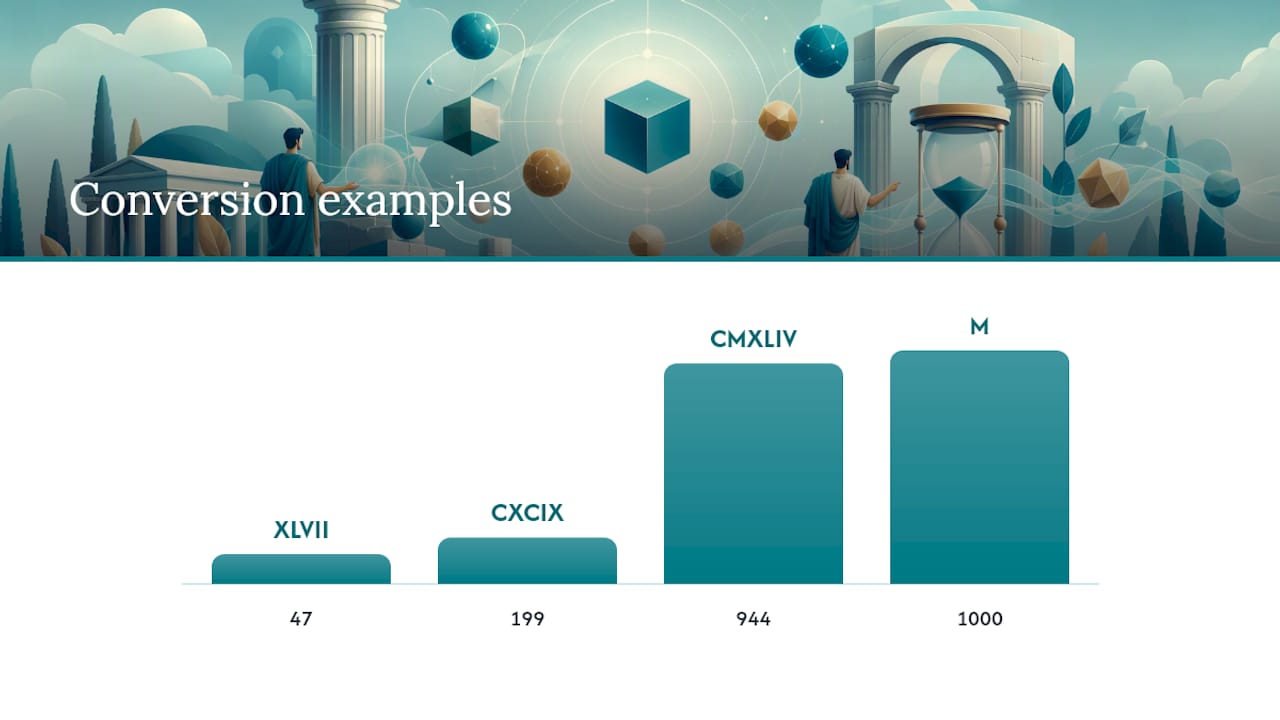
The five-step process from earlier gets a lot more concrete once you run real numbers through it. Here’s the same logic applied to four examples, from simple to tricky.
Converting 47: Split into tens and ones: 40 and 7. Forty uses the subtractive pair XL. Seven is additive: V plus II, or VII. Combine them: XLVII.
Converting 199: Split into hundreds, tens, and ones: 100, 90, 9. One hundred is just C. Ninety is the subtractive pair XC. Nine is the subtractive pair IX. Combine them: CXCIX.
Converting 944: Split into hundreds, tens, and ones: 900, 40, 4. Nine hundred is the subtractive pair CM. Forty is XL. Four is IV. Combine them: CMXLIV.
Converting 1000: No splitting needed. It’s the single symbol M.
- Write down the number and separate it into thousands, hundreds, tens, and ones.
- Convert each segment independently, applying subtractive pairs where the digit is 4 or 9 in its place value.
- Concatenate the segments from largest to smallest.
- Count repeated symbols in your result. Anything beyond three identical symbols in a row signals a mistake.
- Re-parse your finished numeral from left to right, converting it back to a number to confirm it matches your original.
That last step catches most errors before they become a habit. If you convert 47 and get XLVIIII instead of XLVII, re-parsing forces you to notice the four I’s in a row, which immediately flags the subtractive rule you missed.
A quick way to think about the difficulty curve: numbers with 4’s and 9’s in multiple place values (944, 499, 949) are consistently the ones learners get wrong most often, since they require juggling two or three subtractive pairs at once. Numbers built entirely from additive symbols (like 738, or DCCXXXVIII) are more forgiving because there’s no subtraction logic to second-guess.
Interactive converters exist specifically to catch these errors before they turn into wrong answers on a quiz. Britannica’s own converter tool is built for exactly this kind of instant verification, and running your hand-converted answer through any reliable converter, GizmoBench’s included, takes a few seconds and settles the question immediately.
Printable Chart and Practice Worksheets
A physical or downloadable version of this chart tends to stick better than scrolling through it on a screen, especially for younger learners still building number-sense. If you’re setting up a classroom station or a home study sheet, a few formats work better than others:
- Poster size for the full 1 to 1000 chart, pinned somewhere visible for ongoing reference during a unit.
- Flashcard size for the 1 to 100 block specifically, since that range covers the rules students drill most often.
- Single-page handout covering just the seven base symbols and six subtractive pairs, useful as a quick-glance cheat sheet during practice problems.
For practice, pull ten to fifteen random numbers from each of the four ranges above, have students convert them by hand, then check every answer using an interactive converter rather than an answer key alone. That extra step matters: a printed answer key confirms whether a student got the right final numeral, but a converter lets them re-enter their own hand-written answer and see immediately whether it round-trips back to the original number, which catches subtler formatting mistakes an answer key alone would miss.
The GizmoBench Roman Numeral Converter
Checking your work by hand is good practice, but a live converter catches mistakes an answer key can’t always explain. GizmoBench’s Roman numeral converter runs entirely in your browser, needs no account or sign-up, and converts in both directions: type in a plain number and get the numeral, or paste in a numeral and get the number back.
Three uses come up constantly in classroom and self-study settings. First, verification: after converting 944 or 199 by hand, run it through the tool to confirm your answer before moving to the next problem. Second, generating quick chart sections: if you need a custom range beyond what’s printed here, say 1200 to 1250 for an advanced student, the converter builds it on demand. Third, drills: teachers can call out numbers live and have students race to convert before checking against the tool, which turns a static worksheet into something closer to a game.
GizmoBench’s core conversion tools are free to use and don’t require creating an account. If Roman numerals are just one stop in a broader math unit, the site’s number base converter and scientific notation converter cover other number-system topics that pair naturally with this one. Start with the roman numeral converter directly, or browse the full GizmoBench catalog for other classroom-ready tools.
Sources
FAQ
What Are the Seven Roman Numeral Symbols?
The seven base symbols are I (1), V (5), X (10), L (50), C (100), D (500), and M (1,000), and every other Roman numeral is built from combinations of these.
Why Is 4 Written as IV Instead of IIII?
Standard notation avoids more than three repeated symbols in a row, so IV (5 minus 1) replaces IIII, though IIII still appears traditionally on many clock faces.
How Do I Convert 999 Into Roman Numerals?
Split it into 900, 90, and 9: CM, XC, and IX, giving CMXCIX, the longest common numeral in the 1 to 1000 range.
Is There a Roman Numeral for Zero?
No. The system has no symbol for zero, so any number that would require one is written without a placeholder, unlike the Arabic numeral system.
Where Can I Check a Roman Numeral Conversion Instantly?
GizmoBench’s Roman numeral converter converts numbers to numerals and back in your browser, with no account needed, making it a fast way to verify hand-converted answers.