GizmoBench guides
Pythagorean Theorem Proofs for Teachers: Euclid's 7 Step Construction
In any right triangle, the square of the hypotenuse equals the sum of the squares of the other two sides: a² + b² = c². That single equation has dozens of documented proofs, from Euclid’s original geometric argument to algebraic area tricks to a proof credited to a US president. This article walks through six proof families, Euclid’s construction step by step, rearrangement and algebraic derivations, similarity-based reasoning, and worked numeric examples, so students can follow the logic and teachers can reproduce it on a whiteboard.
TL;DR:
- Geometric proofs, like Euclid’s, compare areas through congruent triangles, requiring no algebra and suitable for students unfamiliar with ratios or polynomials.
- Rearrangement proofs physically cut and reassemble shapes, providing intuitive understanding, especially for younger learners, and can be verified with straightforward measurements.
- Algebraic proofs, such as Garfield’s trapezoid method, rely on expanding formulas like (a+b)² or using area calculations, making them quick and accessible for algebra-ready students.
- The similarity proof leverages angle relationships and proportional sides, extending naturally beyond squares to other shapes, emphasizing the role of ratio reasoning in proofs.
- The converse theorem applies to practical measurements like verifying right angles and calculating distances, serving as a foundation for construction and coordinate geometry applications.
Table of Contents
- What Are the Main Types of Pythagorean Theorem Proof?
- How Does Euclid’s Geometric Proof Work?
- How Do Rearrangement and Dissection Proofs Show c² = a² + b²?
- How Do You Prove the Pythagorean Theorem Algebraically?
- Why Does the Altitude to the Hypotenuse Prove the Theorem?
- What Other Historical Proofs Are Worth Knowing?
- Worked Examples: Practice Problems With Answers
- How Should Teachers Sequence These Proofs in Class?
- What Is the Converse and Where Does It Apply?
- Check Your Work: Area and Ratio Calculators for This Proof
- Sources
- FAQ
What Are the Main Types of Pythagorean Theorem Proof?
Rigorous proofs of the theorem cluster into three families: geometric proofs that compare areas directly, algebraic proofs that expand and simplify expressions, and similarity proofs built on proportional triangles. Some categorizations split rearrangement (dissection) proofs out as a fourth style, since they behave more like visual puzzles than formal deductions, even though the underlying logic is still geometric.
Each family serves a different classroom purpose.
- Euclid’s geometric proof builds squares on each triangle side and uses congruent triangles to show the areas match. It suits students who have not yet studied algebra and benefits from careful diagram work.
- Rearrangement and dissection proofs cut shapes into pieces and physically reassemble them into different configurations, which makes them the strongest choice for hands-on, visual, or younger learners.
- Algebraic proofs expand (a+b)² or compute a trapezoid’s area two different ways. They are compact, fast to write on a board, and natural for algebra-first classes already comfortable with polynomial expansion.
- Similarity proofs use the altitude drawn to the hypotenuse to generate three mutually similar triangles, then derive the identity from ratios. These connect directly to later work on proportional reasoning and similar figures.
If you are teaching younger students or introducing the theorem for the first time, start with a rearrangement proof, since it needs no algebra and no formal proof structure. Move to Euclid’s proof when students are ready for congruence arguments, then to the algebraic and similarity proofs once they have the tools to follow ratio and polynomial reasoning. The sections below are written so you can jump straight to whichever proof style fits the lesson you are planning.
How Does Euclid’s Geometric Proof Work?
Euclid’s proof appears as Proposition 47 in Book I of the Elements, and it remains the most cited geometric proof of the theorem. Euclid’s construction builds a square on each side of a right triangle, then shows the square on the hypotenuse has the same area as the two smaller squares combined, using congruent triangles rather than algebra.
Euclid deliberately avoided assumptions about area additivity that later algebraic proofs rely on. He built the argument entirely from congruence and parallelogram equivalence, a structural choice that reflects where Proposition 47 sits in the Elements, before proportion theory is developed in later books, according to commentary comparing Euclid’s approach to algebraic methods. That ordering is worth mentioning to advanced students: Euclid was not simplifying for lack of tools, he was building a proof that stood independent of ideas he had not yet introduced.
Here is the construction, step by step, for a right triangle with the right angle at vertex A:
- Draw squares outward on all three sides: BCED on the hypotenuse BC, and squares on legs AB and AC.
- Draw a line from A perpendicular to BC, extending it to meet DE (the far side of the hypotenuse square) at a point, splitting square BCED into two rectangles.
- Draw segment AD and segment CF (where F is a vertex of the square on AB), forming two new triangles.
- Show triangle ABD is congruent to triangle FBC using the side-angle-side criterion, since AB equals FB, BD equals BC, and the included angles are equal once you account for the shared angle B plus two right angles.
- Because triangle ABD and triangle FBC are congruent, they have equal area. Triangle FBC has exactly half the area of the square on AB (they share a base and height), and triangle ABD has half the area of the left rectangle formed in step 2.
- Repeat the same congruence argument on the other side, matching triangle ACD’s partner triangle to the square on AC and the right rectangle.
- Since each rectangle equals its matching square’s area, and the two rectangles together make up the full square on the hypotenuse, the square on BC equals the square on AB plus the square on AC.
Every step relies on triangles that share a base and height with a square or rectangle, so their areas are locked at exactly half. That is the entire trick: Euclid never measures a length, he only compares areas through congruence.
To check the logic numerically, take a 3-4-5 triangle. The square on the leg of length 3 has area 9, the square on the leg of length 4 has area 16, and 9 plus 16 equals 25, exactly the area of the square on the hypotenuse of length 5. Euclid’s proof guarantees this equality holds for every right triangle, not just this one, because the congruence argument never depends on specific side lengths.
Pro Tip: Label every new point Euclid’s construction introduces (D, E, F, and so on) consistently with the original source, and mark right angles with small squares at each vertex. Students lose the thread fastest when a diagram reuses a letter for two different points or leaves right angles unmarked.
How Do Rearrangement and Dissection Proofs Show c² = a² + b²?
Rearrangement proofs show the identity by physically cutting shapes apart and reassembling the same pieces into a different arrangement, proving two areas are equal because they are made of literally the same material. The most common version is the four-triangle square proof, and it is often the first proof students actually understand, because nothing needs proving beyond “these pieces fit.”
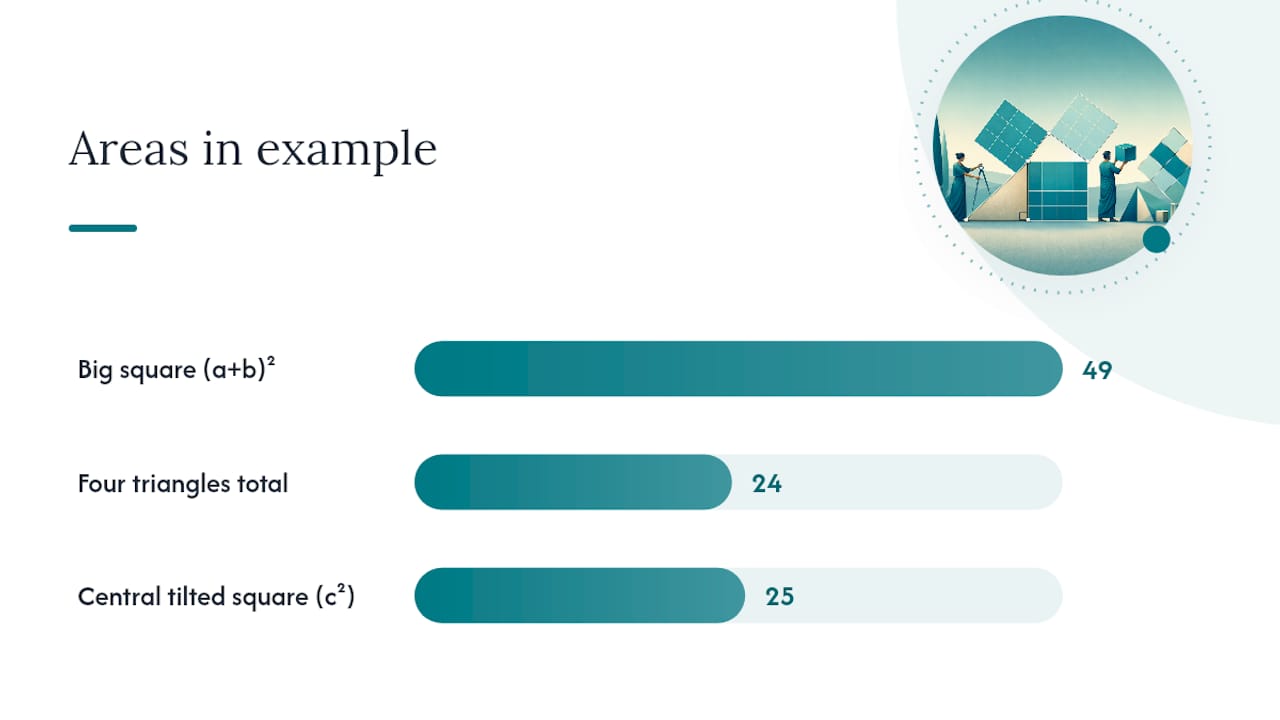
Start with a large square whose side length is (a+b). Inside it, place four congruent copies of the right triangle, each rotated 90 degrees from the last, so their hypotenuses form a smaller square in the middle with side length c. The big square’s area is (a+b)². That same big square also equals the area of the four triangles plus the small tilted square in the center: 4 times (½ab) plus c², which simplifies to 2ab + c². Setting the two expressions for the big square’s area equal gives (a+b)² = 2ab + c², and expanding the left side turns this into a² + 2ab + b² = 2ab + c². The 2ab terms cancel, leaving a² + b² = c².
A second classical version, sometimes linked to the 12th-century mathematician Bhaskara, skips the algebra entirely. Bhaskara’s diagram shows the same four triangles rearranged around the square on the hypotenuse so their leftover space forms two smaller squares, with areas a² and b², filling exactly the same footprint the large square occupied. Cut-the-Knot’s collection catalogs several rotation variants of this dissection, some of which need only two cuts to convert the two leg-squares into the hypotenuse square directly.
A quick 3-4-5 check confirms the areas line up: the big square in the four-triangle construction has side (3+4) = 7, so its area is 49. The four triangles each have area ½(3)(4) = 6, for a combined 24, and the central tilted square has area 5² = 25. Adding 24 and 25 gives 49, matching the big square exactly.
- Cut four identical right-triangle pieces from cardstock, then let students physically arrange them inside a square outline to discover the tilted inner square themselves before you name it.
- Have students trace the leftover space in Bhaskara’s arrangement and measure it against the two leg-squares cut separately.
- Photograph each rearrangement stage if you plan to reuse the activity, since reassembling pieces from scratch each class period eats into lesson time.
One frequently cited fact about this style of proof: the Cut-the-Knot archive alone documents dozens of distinct dissection and algebraic variants, which is a strong signal of how many independent ways mathematicians have found to arrive at the same 2,000-plus-year-old equation.
How Do You Prove the Pythagorean Theorem Algebraically?
Algebraic proofs get to a² + b² = c² by computing one area two different ways and letting the algebra do the work, rather than relying on congruent-triangle arguments. The four-triangle square construction from the previous section already contains one: expand (a+b)² into a² + 2ab + b², compare it to 2ab + c², and cancel the shared 2ab term.
A more elegant algebraic proof, and one with an unusual origin, comes from James Garfield, who devised it in 1876 while serving in the US House of Representatives, five years before his presidency. Garfield’s proof uses a trapezoid instead of a square.
- Take two copies of the same right triangle with legs a and b and hypotenuse c. Arrange them so their two legs of length a and b form a straight line together, creating a trapezoid with parallel sides a and b and height (a+b).
- Compute the trapezoid’s area using the standard trapezoid formula: ½(a+b)(a+b), which simplifies to ½(a+b)².
- Compute the same trapezoid’s area a second way, by adding up its three internal triangles: two copies of the original right triangle, each with area ½ab, plus a third right triangle formed where the two hypotenuses meet, with legs c and c and area ½c².
- Set the two area expressions equal: ½(a+b)² = 2(½ab) + ½c², which becomes ½(a+b)² = ab + ½c².
- Multiply everything by 2 and expand the left side: a² + 2ab + b² = 2ab + c². Cancel 2ab from both sides to get a² + b² = c².
Garfield’s version is popular in classrooms precisely because it needs only the trapezoid area formula and basic expansion, no congruence theorems at all. To verify it numerically, use the 3-4-5 triangle again: the trapezoid has parallel sides 3 and 4, height 7, giving area ½(7)(7) = 24.5. The three internal triangles give ½(3)(4) + ½(3)(4) + ½(5)(5) = 6 + 6 + 12.5 = 24.5. Both methods agree.
Why Does the Altitude to the Hypotenuse Prove the Theorem?
Dropping a perpendicular from the right angle to the hypotenuse splits the original triangle into two smaller triangles, and both of those smaller triangles are similar to the original, which is the entire engine behind the similarity proof. Similarity here means all three triangles have identical angles, just scaled to different sizes, so their corresponding sides stay in fixed proportion to each other.
Label the right triangle ABC with the right angle at A, and let D be the point where the altitude from A meets hypotenuse BC. Triangle ABD, triangle ACD, and the original triangle ABC all share the same three angles, just arranged differently, which makes all three similar by the angle-angle criterion.
From the similarity of triangle ABD and triangle ABC, the ratio AB to BC equals the ratio BD to AB, which rearranges to AB² = BD times BC. The ProofWiki derivation of this classic proof lays out the same segment-product identity: AC² = DC times BC follows from the matching similarity between triangle ACD and triangle ABC.
- AB² = BD · BC (from the smaller left triangle’s similarity to the whole)
- AC² = DC · BC (from the smaller right triangle’s similarity to the whole)
- Adding both equations: AB² + AC² = BD·BC + DC·BC = BC(BD + DC)
- Since BD + DC together make up the entire hypotenuse BC, the right side simplifies to BC · BC = BC²
- That gives AB² + AC² = BC², the Pythagorean theorem in different letters
What makes this proof worth teaching alongside Euclid’s is what it reveals about generalization. Because the argument depends only on proportional relationships between similar shapes, not specifically on squares, it extends naturally to figures built from any similar shape on each side, not just squares, an idea Euclid develops in later propositions once proportion theory has been formally introduced. Emphasizing the segment-product identities (AB² = BD·BC) as a direct consequence of pure ratio reasoning, rather than as an algebraic shortcut, helps students see why similarity proofs are considered just as rigorous as Euclid’s original.
What Other Historical Proofs Are Worth Knowing?
Beyond the main four families, a handful of shorter or historically distinctive proofs are worth keeping in your back pocket for enrichment days or a five-minute warm-up.
- Garfield’s trapezoid proof, covered in full above, remains the most cited example of a proof discovered outside professional mathematics, credited to future US president James Garfield in 1876.
- The Chou Pei Suan Ching, an ancient Chinese mathematical text, contains a diagram widely interpreted as an early visual demonstration of the 3-4-5 case, predating many Western dissection proofs by centuries and reflecting how independently different mathematical traditions arrived at the same relationship.
- Loomis’s catalog, a well-known 20th-century compilation, organizes historical proofs by method (algebraic, geometric, and so on) and numbers them individually, which is why some math references cite proofs by a specific catalog number rather than by name.
- Short coordinate-geometry variants derive the theorem directly from the distance formula, useful once students have already studied coordinate systems and want to see the theorem’s algebraic side stripped to its bones.
For readers who want to go beyond the six proofs covered here, Cut-the-Knot’s dedicated collection is the most complete freely available archive, with dozens of interactive variants spanning dissection, algebraic, and similarity styles. It is a strong second stop after this article for anyone building a full unit or a proof-a-day enrichment calendar.
Worked Examples: Practice Problems With Answers
The fastest way to internalize any of these proofs is to run the numbers yourself, so here are two fully worked examples followed by three practice problems.
Example 1: The 3-4-5 triangle, checked two ways. Using the four-triangle rearrangement proof, build the large square with side (3+4) = 7, area 49. Four triangles at ½(3)(4) = 6 each contribute 24 total, and the central square has area c² where c is unknown. Since 49 minus 24 equals 25, c² = 25, so c = 5. Confirm algebraically: 3² + 4² = 9 + 16 = 25 = 5².
Example 2: Non-integer legs, checked with the similarity proof. Take a right triangle with legs a = 2.5 and b = 6. First find c using the theorem: c² = 2.5² + 6² = 6.25 + 36 = 42.25, so c = 6.5. Now verify using the altitude proof. The altitude to the hypotenuse divides c = 6.5 into segments BD and DC. Using AB² = BD·BC, with AB = 2.5 and BC = 6.5, BD = 6.25 / 6.5 ≈ 0.9615. Using AC² = DC·BC, with AC = 6, DC = 36 / 6.5 ≈ 5.5385. Adding BD and DC gives 0.9615 + 5.5385 = 6.5, matching BC exactly, which confirms the segments were computed correctly.
- A right triangle has legs 6 and 8. Find the hypotenuse. Answer: 6² + 8² = 36 + 64 = 100, so c = 10.
- A right triangle has hypotenuse 13 and one leg 5. Find the other leg. Answer: 13² minus 5² = 169 minus 25 = 144, so the missing leg = 12.
- Verify that 9, 12, and 15 form a Pythagorean triple. Answer: 9² + 12² = 81 + 144 = 225, and 15² = 225. The triple checks out, and it is simply the 3-4-5 triple scaled by 3.
Pro Tip: When practicing with decimal legs, compute each squared value separately before adding, and round only at the very last step. Rounding early, especially inside the similarity proof’s segment ratios, compounds small errors fast.
How Should Teachers Sequence These Proofs in Class?
Sequence proofs from concrete to abstract: start with a rearrangement proof students can physically cut and rebuild, move to Euclid’s congruence argument once students trust area comparisons, then introduce the algebraic and similarity proofs when the class is comfortable with expansion and ratios. Jumping straight to Euclid’s full construction with students who have never compared shape areas before tends to produce memorization rather than understanding.
A few classroom activities consistently work well across grade levels:
- Cut-and-paste dissection using cardstock triangles, letting students discover the tilted inner square in the four-triangle proof before you name it.
- Guided derivation on the board, where you write only the setup for Garfield’s trapezoid proof and let students fill in the algebra steps.
- Small-group proof presentations, where each group is assigned a different proof family and explains it to the rest of the class using their own diagram.
Interactive, hands-on demonstrations paired with simple numeric checks tend to help students retain the material better than lecture alone, according to guidance from MathisFun’s stepwise expositions, which are built specifically around paper-cut exercises for classroom use.
Coupling those activities with an in-browser calculator removes the arithmetic friction that otherwise eats into class time. GizmoBench’s Area Calculator shows the formula it used alongside the result, which makes it useful for quickly confirming a rearrangement proof’s area totals during a lesson rather than working them by hand at the board. The Ratio Calculator serves a similar purpose for the similarity proof, checking whether the segment proportions students calculate by hand (BD to AB, DC to AC) actually match before moving on. Both tools run directly in the browser with no account required, which matters in a classroom setting where creating logins for every student is impractical.
What Is the Converse and Where Does It Apply?
The converse of the Pythagorean theorem states that if a triangle’s sides satisfy a² + b² = c², the triangle must contain a right angle opposite side c. The proof works by constructing a second triangle with the same leg lengths a and b and a genuine right angle between them, then showing its hypotenuse must also equal c through the standard theorem, which forces the two triangles to be congruent and therefore forces the original angle to be a right angle too.
This converse is what makes the theorem practically useful outside the classroom, since the theorem itself underlies the Euclidean distance formula, meaning it defines how distance is measured in flat, two-dimensional space rather than just describing triangles, according to background from the Wikipedia entry on the theorem.
- Builders and carpenters use the 3-4-5 rule directly from the converse: mark 3 units along one wall and 4 along the adjoining wall, and if the diagonal between those marks measures exactly 5 units, the corner is square. Common Pythagorean triples like 5-12-13 and 8-15-17 work the same way at larger scales.
- Coordinate geometry uses the same relationship to compute the straight-line distance between two points, treating the horizontal and vertical differences as the two legs of a right triangle.
- Anyone laying out a garden bed, a deck, or a foundation corner can use the converse as a fast field check without any specialized tools, and GizmoBench’s Square Footage Calculator helps confirm the resulting area once the corners are square.
Check Your Work: Area and Ratio Calculators for This Proof
Every proof in this article leans on comparing areas or comparing ratios, and getting either wrong by even a small arithmetic slip breaks the whole argument. GizmoBench’s Area Calculator computes area for squares, triangles, and other shapes and displays the formula it used, so you can verify a rearrangement proof’s totals, like the 24 plus 25 equals 49 check from the four-triangle construction, without redoing the multiplication by hand.
The Ratio Calculator simplifies ratios and solves proportions, which makes it a direct fit for the similarity proof’s segment identities. Plug in the similarity relationship from triangle ABD and triangle ABC, and confirm the proportion resolves to the same BD·BC value used to derive AB². Both tools run in the browser with no sign-up and no file upload, and the core calculation functions are free to use, which matters for a classroom or a quick homework check where creating an account is friction nobody wants. If you are working through a broader unit that also touches percentages, unit conversions, or averaging quiz scores across a class, GizmoBench’s catalog at Gizmobench covers those needs too. Open the Area Calculator now, plug in your triangle’s leg lengths, and check your rearrangement proof’s arithmetic before you put it on the board.
Sources
- Pythagorean theorem — Wikipedia
- Euclid’s Elements, Book I, Proposition 47 — Clark University
- Pythagorean theorem and its many proofs — Cut-the-Knot
- Pythagoras — MathisFun
- ProofWiki — Classic proof (similarity)
FAQ
Who Was the President Credited With a Pythagorean Theorem Proof?
James Garfield devised the trapezoid-based algebraic proof covered earlier in this article in 1876, five years before he became the 20th US president.
Is There a New Proof of the Pythagorean Theorem?
Mathematicians and students continue to find new variations on established proof families, since the theorem’s proof space (geometric, algebraic, similarity, and dissection methods) is broad enough that fresh combinations of known techniques still surface regularly.
Is There Historical Evidence for Pythagoras Himself?
Historical evidence for Pythagoras as an individual is limited and largely secondhand, since none of his own writings survive, though the theorem bearing his name was documented and used in multiple ancient cultures, including in the Chinese Chou Pei Suan Ching, independent of any direct link to Pythagoras.
Have High School Students Discovered New Proofs?
Students occasionally produce original proofs or novel variations as classroom projects, particularly through similarity-based or dissection approaches, since those methods leave room for creative construction choices even within a rigorously defined proof.
How Can I Check My Own Pythagorean Theorem Calculations?
Verify area-based steps with GizmoBench’s Area Calculator and proportion steps with the Ratio Calculator, both of which display the formula used alongside the result.