GizmoBench guides
Fraction to Decimal: 2 Fast Methods and a Browser Check for Students
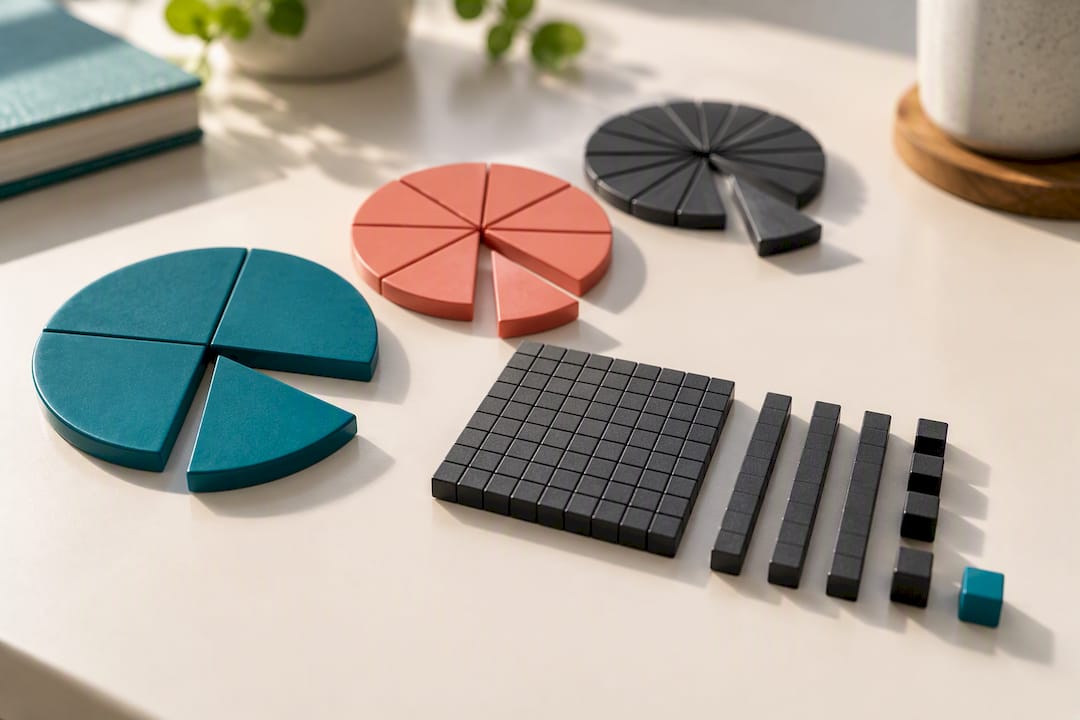
To convert a fraction to a decimal, divide the numerator by the denominator. That single step handles every case, including mixed numbers once you turn them into improper fractions first. Some answers stop cleanly (like 0.75), while others repeat forever (like 0.666…). If you want to check your work fast, GizmoBench’s browser-based converters give you an instant second opinion.
TL;DR:
- Fractions with denominators that only contain prime factors 2 and/or 5 will always convert to terminating decimals, easing quick mental or manual conversion.
- Long division reliably reveals repeating decimals when the denominator includes other prime factors, with repeating cycles predictable and often indicated with bar or parentheses notation.
- Converting mixed numbers involves transforming them into improper fractions, then dividing, though quick methods exist for denominators of 4, 8, or 10 to save time.
- Use calculator tools to verify long division results, especially for complex repeating decimals or when checking multiple answers, but rely on manual division for understanding foundational concepts.
- Always double-check answers before submitting, using dedicated online tools if necessary, to avoid common errors like misaligned remainders or misplaced decimal points.
Table of Contents
- What Is the Fastest Way to Change a Fraction to a Decimal?
- Worked Examples: Common Fractions Converted to Decimals
- Why Do Some Fractions Repeat Forever?
- How Do You Convert Mixed Numbers to Decimals?
- How Do You Turn a Decimal Into a Percent?
- When Should You Use a Calculator to Check Your Work?
- Verify Every Answer Before You Turn It In
- Where These Methods and Tables Come From
- Sources
- FAQ
What Is the Fastest Way to Change a Fraction to a Decimal?
There are two ways to get there: the quick route and the long-division route. Which one you need depends on whether the denominator divides evenly into a power of ten.
The quick method works when you can mentally scale the fraction. Take 3/4. Multiply both numerator and denominator by 25 and you get 75/100, which is just 0.75. This trick works instantly for denominators like 2, 4, 5, 10, 20, 25, and 50, because they all divide evenly into 10, 100, or 1,000.
Long division is the reliable fallback for everything else. Here’s the process:
- Set up the numerator as the dividend and the denominator as the divisor.
- Add a decimal point and a zero after the numerator if it doesn’t divide evenly (so 7 becomes 7.0, then 7.00, and so on as needed).
- Divide as usual, bringing down each zero and recording the quotient digit above it.
- Track the remainder at each step. If the remainder ever repeats a value you’ve already seen, the decimal has started repeating.
- Stop when the remainder hits zero (a terminating decimal) or when you spot the repeating cycle.
You can predict which outcome you’ll get before you even start dividing. If the denominator’s only prime factors are 2 and/or 5, the decimal terminates. Any other prime factor in the denominator (3, 7, 11, and so on) guarantees a repeating decimal. That’s why 1/8 (denominator = 2×2×2) ends cleanly at 0.125, while 1/3 never stops.
When an assignment or calculator asks for a set number of decimal places, round only after you’ve completed the division; rounding mid-process compounds errors.
Pro Tip: Before you divide, check the denominator’s factors. If it only breaks down into 2s and 5s, you already know the answer will terminate, and you can skip the guesswork about how many decimal places to expect.
Worked Examples: Common Fractions Converted to Decimals
Seeing the arithmetic side by side with the shortcut method makes the pattern click faster than reading rules in isolation.
- 1/2 → 1 ÷ 2 = 0.5 (or scale to 5/10)
- 1/4 → 1 ÷ 4 = 0.25 (scale to 25/100)
- 3/4 → 3 ÷ 4 = 0.75 (scale to 75/100)
- 1/5 → 1 ÷ 5 = 0.2 (scale to 2/10)
- 1/10 → 1 ÷ 10 = 0.1 (already in tenths)
- 3/8 → 3 ÷ 8 = 0.375 (long division: 3.000 ÷ 8, quotient digits 3, 7, and 5)
Now the repeating case. Take 2/3. Set up 2.000 ÷ 3. The first division step gives 6 with a remainder of 2. Bring down the next zero, divide again, and you get another 6 with a remainder of 2. That remainder never changes, so the 6 repeats endlessly: 2/3 = 0.666…
A conversion table covering the fractions students see most often looks like this:
Keep this list nearby when you’re checking homework. It’s faster than re-running long division every time you hit a familiar fraction.
Why Do Some Fractions Repeat Forever?
Repeating decimals happen because long division eventually runs out of new remainders to produce. Once a remainder repeats, the digits above it repeat too, in the exact same order, forever.
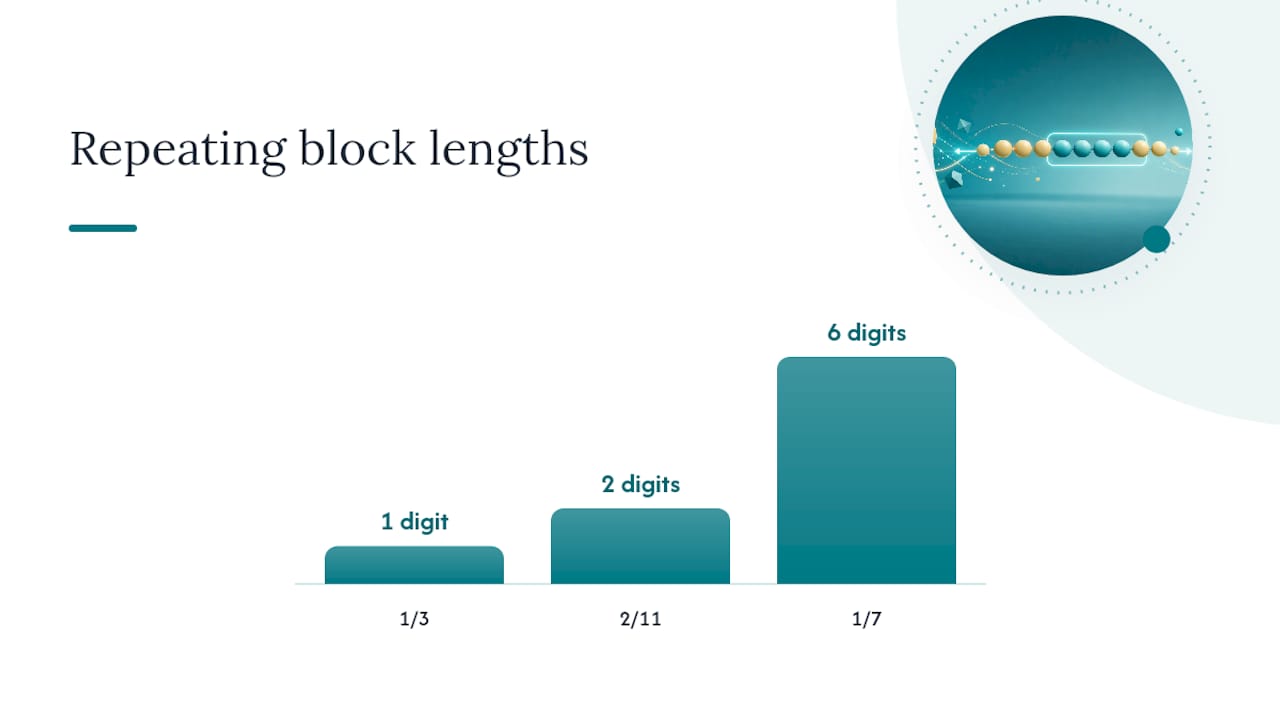
This is why denominators built only from 2s and 5s always terminate. Every other prime factor, like 3, 7, or 11, forces the division into a cycle it can never escape. The Math2.org conversion tables list these repeating patterns explicitly, which is useful when you want to confirm a pattern without redoing the division by hand.
Writing repeating decimals correctly matters for math class. Two notations are standard:
- Bar notation (vinculum): a horizontal line drawn over the repeating digits, like 0.6 with a bar over the 6, meaning 0.666…
- Parentheses: the repeating block enclosed in parentheses, like 0.(36) for a decimal that repeats “36” indefinitely.
A few examples show how the repeating block can vary in length. 1/3 repeats a single digit: 0.(3). 1/7 repeats a six-digit block: 0.(142857). 2/11 repeats a two-digit block: 0.(18). The length of the cycle depends entirely on the denominator, and spotting where the digits start looping again is the whole trick to writing the notation correctly.
How Do You Convert Mixed Numbers to Decimals?
Mixed numbers need one extra step before division, but the logic doesn’t change.
- Convert the mixed number to an improper fraction (multiply the whole number by the denominator, add the numerator, and keep the same denominator).
- Divide the new numerator by the denominator, exactly as you would for any other fraction.
- Alternatively, convert just the fractional part to a decimal and add it to the whole number directly.
Take 2 3/8. Turning it into an improper fraction gives 19/8 (2 × 8 = 16, plus 3 = 19). Dividing 19 by 8 gives 2.375.
The mental-math shortcut skips the improper-fraction step entirely: convert 3/8 to 0.375 on its own, then just add the whole number 2, landing on the same 2.375. For simple denominators like 4, 8, or 10, this shortcut is often faster than rewriting the whole fraction.
How Do You Turn a Decimal Into a Percent?
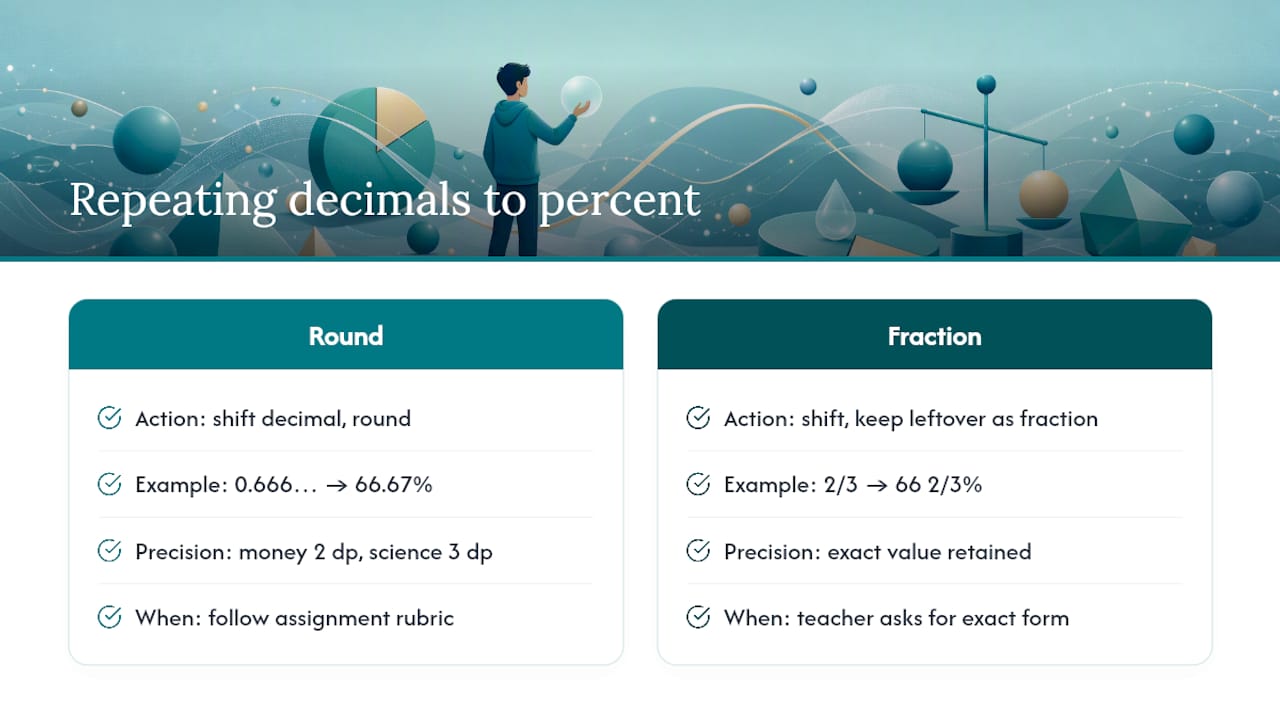
Once you have a decimal, converting it to a percent takes one move: shift the decimal point two places to the right and attach a percent sign.
Repeating decimals complicate that shift slightly. You have two accepted options when converting a repeating decimal to a percent: round to a sensible number of places, or express the leftover portion as a fraction within the percent. For 2/3, that means either rounding 0.666… or expressing it as a fraction within the percent. Both are mathematically valid; which one you use usually comes down to what the assignment asks for.
Rounding conventions vary by context. Money-related answers typically call for two decimal places, while measurement or scientific work sometimes needs three for added precision. Check your assignment’s instructions before you round, since a teacher’s rubric almost always specifies which convention applies.
When Should You Use a Calculator to Check Your Work?
Doing the division by hand is how the concept sticks. But once you understand why 1/3 repeats and why 3/8 doesn’t, running every problem through long division stops being useful and starts being slow.
- Use manual division to learn the method the first several times.
- Switch to a calculator when you’re checking a batch of answers or confirming whether a decimal repeats or terminates.
- Watch how the tool displays repeating digits. Some round automatically; others show the full repeating block.
GizmoBench’s percentage calculator runs entirely in your browser, with no account or upload required, which matters if you’d rather not hand a school assignment over to a random sign-up form. Enter your numerator and denominator, and it returns the decimal instantly, so you can compare it against your own long-division work.
Pro Tip: If your decimal answer doesn’t match a calculator’s output, recheck your remainder trail first. A single dropped zero during long division is the most common reason manual answers land one decimal place off.
Verify Every Answer Before You Turn It In
GizmoBench builds tools that run directly in your browser, no downloads and no account required, so checking a fraction conversion takes seconds instead of a search through your notes. If you’ve just worked through a repeating decimal by hand and want a fast second opinion, the percentage calculator confirms the decimal-to-percent conversion instantly, and the broader set of everyday calculators covers related tasks like unit conversions and quick math checks without asking you to create a login. Open the tool, plug in your numbers, and compare the result against your worked answer before you submit your homework.
Where These Methods and Tables Come From
- Percent conversion and rounding conventions follow Purplemath’s guide to fractions and percents.
- Common fraction-to-decimal values and repeating-digit patterns come from Math2.
- Step-by-step long-division examples for grade-level practice are drawn from LumosLearning’s guided practice.
Sources
- Fractions to percents (some with fractions, too!) | Purplemath
- Fraction to Decimal Conversion Tables
- Convert Fractions To Decimal | Grade 4 Math (4.NF.C.6)
FAQ
What Is 5/8 as a Decimal?
5/8 equals 0.625. Dividing 5 by 8 through long division gives quotient digits 6, 2, and 5, and the remainder hits zero, so the decimal terminates.
What Is 1/4 as a Decimal?
1/4 equals 0.25. You can find this by dividing 1 by 4, or by scaling the fraction to 25/100, which reads directly as 0.25.
How Do You Turn 3/8 Into a Decimal?
Divide 3 by 8 using long division: 3.000 ÷ 8 gives quotient digits 3, 7, and 5, landing on 0.375. Since 8’s only prime factor is 2, the decimal terminates cleanly with no repeating digits.
How Do You Turn 2/3 Into a Decimal?
Dividing 2 by 3 produces a repeating remainder of 2 at every step, so the digit 6 repeats forever: 2/3 = 0.666…, written as 0.(6) in parentheses notation. Because 3 isn’t a factor of 2 or 5, this fraction can never terminate.