GizmoBench guides
3 Ways to Use the Percentage Formula, and 4 Setup Mistakes to Avoid

The percentage formula comes down to one relationship, expressed three ways depending on what you know. To find a percent, divide the part by the whole and multiply by 100. To find the part, multiply the percent (as a decimal) by the whole. To find the whole, divide the part by the percent expressed as a decimal. A related formula, percent change, equals the new value minus the original, divided by the original, times 100.
TL;DR:
- Percentages can exceed 100% when the part is larger than the whole, which often occurs in growth or comparison problems.
- Calculating percent involves dividing the part by the whole and multiplying by 100, and the reverse works for finding the entire amount from a part and a percentage.
- Using the decimal form (percent divided by 100) is consistent across formulas and helps prevent common setup errors.
- Percent change measures relative movement using the original value as the denominator, with a positive sign indicating an increase and a negative sign indicating a decrease.
- Mistakes like swapping part and whole or forgetting to convert percent to a decimal before calculation are frequent setup errors that distort results.
Table of Contents
- What a Percentage Formula Actually Measures
- Core Formulas: Three Solver Forms and How to Check Them
- Percent Change: Increases, Decreases, and a Common Mix-Up
- Converting Between Percent, Decimal, and Fraction Fast
- Setup Mistakes That Wreck an Otherwise Correct Calculation
- Worked Examples: Tips, Discounts, and Reverse Percentages
- Percentage Error: Measuring How Far Off an Estimate Really Is
- Percentage Points vs. Percent Change in Practice
- Percentages in Statistics and Probability
- Compound Interest: Percentages That Multiply on Themselves
- Percentage Composition in Chemistry and Nutrition Labels
- Check Your Percentage Math With GizmoBench
- Sources
- FAQ
What a Percentage Formula Actually Measures
A percentage is a fraction scaled to parts per hundred. That’s why the formula is (part ÷ whole) × 100: dividing gives you the fraction, and multiplying by 100 rescales it to a per-hundred value.
Percent, decimal, and fraction are three faces of the same number. 25% equals 0.25 equals 1/4. Word problems tend to hide the formula in ordinary language, and learning to spot the pattern saves time. The phrase after “of” is almost always the base (the whole), and the phrase after “is” is almost always the part, according to a percent equation guide. “What is 20% of 70?” translates directly to percent × base = amount.
A few things worth knowing before you start plugging in numbers:
- Percent literally means “per hundred,” from the Latin per centum.
- A percentage can exceed 100% whenever the part is larger than the base, which happens constantly in growth and comparison problems, per the college mathematics reference on percentage basics.
- Converting between percent, decimal, and fraction never changes the underlying value, only its format.
Core Formulas: Three Solver Forms and How to Check Them
The percent equation is often written as P × B = A, where P is the percent (as a decimal), B is the base or whole, and A is the amount or part. Knowing any two of the three lets you solve for the missing one through basic algebra, as laid out in the basic percent equation reference. Here are the three rearrangements you’ll use for almost every real-world problem.
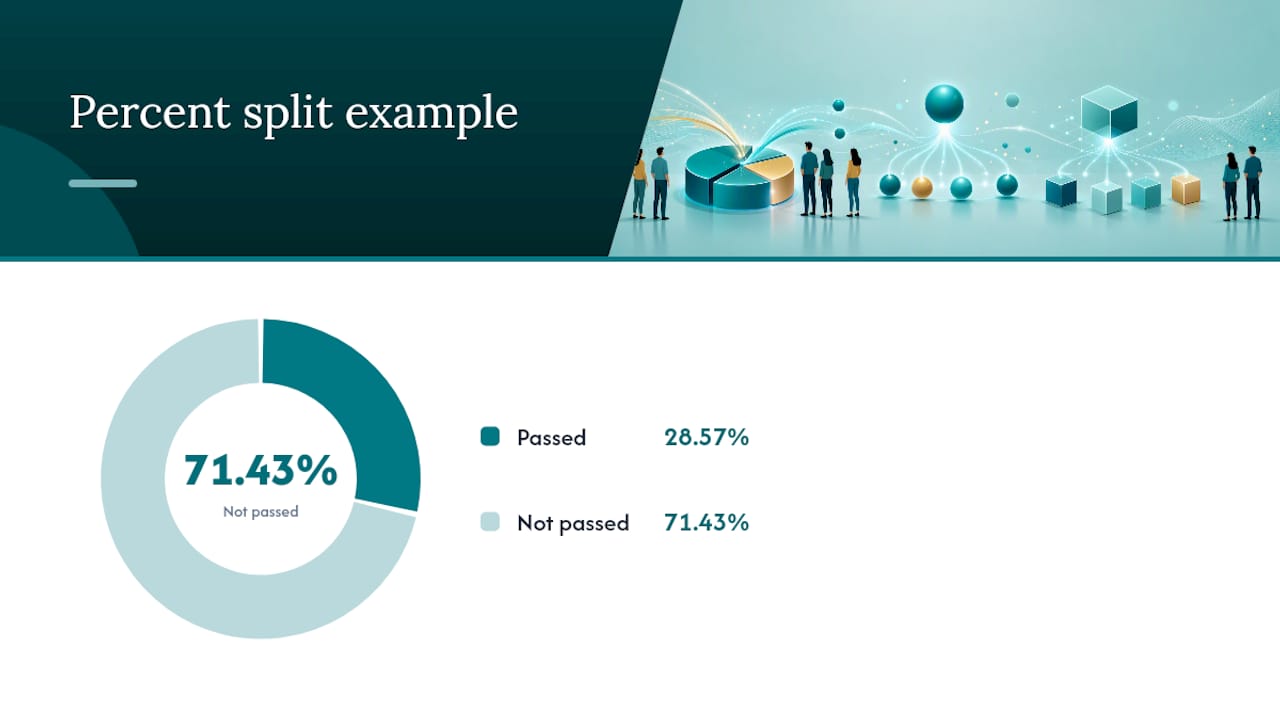
- Find the percent. Percent = (part ÷ whole) × 100. If 20 out of 70 students passed a quiz, that’s (20 ÷ 70) × 100 ≈ 28.57%.
- Find the part. Part = (percent ÷ 100) × whole. 20% of 70 is (20 ÷ 100) × 70 = 14.
- Find the whole. Whole = part ÷ (percent ÷ 100). If 14 is 20% of some number, that number is 14 ÷ 0.20 = 70.
Notice the decimal conversion running through every version: 20% isn’t used as “20” in the math, it’s used as 0.20. That single step trips up more calculations than anything else in this topic.
For a quick sanity check, plug your answer back into the original relationship. This reverse check works for any of the three forms and takes about ten seconds once you’re used to it. Spreadsheet tools apply the same underlying logic. Microsoft’s own guidance on calculating percentages recommends storing percentages as decimals in cells so formulas stay consistent across a sheet, which mirrors exactly the decimal-first approach above.
Percent Change: Increases, Decreases, and a Common Mix-Up
Percent change follows a different formula from a straight percentage. It measures movement, not composition: percent change = ((new value − original value) ÷ original value) × 100. The percent change explanation confirms the original, or starting, value is always the denominator, never the new one.
The sign tells you the direction. A positive result means an increase; a negative result means a decrease. If you only care about the size of the swing and not its direction, take the absolute value. But in most financial and scientific contexts, direction matters just as much as magnitude, so don’t strip the sign automatically.
- Price rises from $45 to $54: ((54 − 45) ÷ 45) × 100 = 20% increase.
- Price falls from $45 to $39: ((39 − 45) ÷ 45) × 100 ≈ 13.3% decrease.
- Always divide by the starting number, even when the starting number is smaller than the ending one.
Percentage points are not the same thing as percent change, and mixing them up is one of the most common reporting errors in news and finance. But expressed as a relative percent change, it’s ((50 − 40) ÷ 40) × 100 = 25%, according to the college mathematics section on absolute and relative change. Both numbers are correct. They just answer different questions.
Converting Between Percent, Decimal, and Fraction Fast
Going the other direction, multiply the decimal by 100 and move the point two places right. This two-step shuffle is the backbone of every formula above, so it’s worth being automatic with it before you tackle word problems.
Recognizing these on sight speeds up mental estimates dramatically.
Divide the whole by 100 to find 1%, then multiply by whatever percent you need, a technique BBC Bitesize recommends as an accessible fallback when a calculator isn’t handy.
- For 10%, just move the decimal point one place left.
- For 5%, find 10% and cut it in half.
- For 1%, move the decimal point two places left.
10% of $52 is $5.20, so 20% is $10.40 and 15% sits right between them at $7.80.*
Setup Mistakes That Wreck an Otherwise Correct Calculation
Most percentage errors happen before any math is done, in how the problem gets set up. The basic percent equation workflow flags the same handful of mistakes repeatedly.
- Swapping part and whole. If you divide the whole by the part instead of the reverse, you’ll get a number well over 100% where you expected a fraction.
- Forgetting to divide the percent by 100. Using 20 instead of 0.20 in a multiplication inflates the result twentyfold.
- Using the wrong denominator in a percent change. Dividing by the new value instead of the original value skews the result, especially on larger swings.
- Confusing percentage points with percent change, which produces a technically true but misleading number.
A quick checklist prevents most of this: identify your three quantities (percent, part, whole) before writing anything down, convert the percent to a decimal, run the calculation, then verify by working the formula backward. On rounding, hold onto full decimal precision through every intermediate step and only round the final answer, since rounding too early compounds small errors into visibly wrong results on multi-step problems.
Worked Examples: Tips, Discounts, and Reverse Percentages
These four examples cover the situations readers run into most: finding a percent of a number, calculating a tip, and working backward from a part to find the whole.
- 20% of 70. Decimal method: (20 ÷ 100) × 70 = 0.20 × 70 = 14. 1% method: 70 ÷ 100 = 0.7, then 0.7 × 20 = 14. Both land on 14, confirming the setup was correct.
- 20% of 45. (20 ÷ 100) × 45 = 0.20 × 45 = 9. Verify by dividing 9 by 45 and multiplying by 100, which returns 20%, exactly where you started.
- A 15% tip on a $45 bill. 0.15 × 45 = $6.75. If you want a mental shortcut, find 10% ($4.50), then half of that again for 5% ($2.25), and add them together for $6.75.
- Reverse percentage: 45 is 30% of what number? Whole = 45 ÷ 0.30 = 150. Check by taking 30% of 150: 0.30 × 150 = 45, which matches the original part.
The fastest way to catch a percentage mistake isn’t a more careful first calculation. It’s running the formula backward once you have an answer. If dividing 14 by 70 doesn’t return 20%, something in the setup went wrong before you ever touched a calculator.
For anything more involved than mental math, plugging the same numbers into a percentage calculator gives you an instant cross-check without retyping the formula by hand.
Percentage Error: Measuring How Far Off an Estimate Really Is
Percentage error tells you how far a measured or estimated value strays from the true or accepted value, expressed as a percent of that true value. The formula is percentage error = (|measured value − true value| ÷ true value) × 100. It follows the same skeleton as percent change, just with “true value” standing in for “original value” and an absolute value applied so the result reads as a magnitude rather than a signed direction.
Say a recipe calls for exactly 250 grams of flour, but a kitchen scale reads 240 grams. Percentage error only tells you the size of the gap. It doesn’t tell you whether that gap matters, which depends entirely on the context and the standard you’re measuring against.
This calculation shows up constantly in science classes, manufacturing quality checks, and even budgeting, where a projected cost gets compared against the actual cost once the bills arrive.
One detail worth flagging: percentage error always uses the true or accepted value as the denominator, the same rule that governs percent change. Divide by the measured or estimated value instead, and the result skews in a way that misrepresents how far off the estimate actually was.
Percentage Points vs. Percent Change in Practice
The distinction between percentage points and percent change comes up constantly in news coverage of unemployment rates, interest rates, and election polling, and it’s frequently reported in a way that muddies the two together. An earlier section introduced the core difference: percentage points measure a direct subtraction between two percentages, while percent change measures that same movement relative to the starting figure.
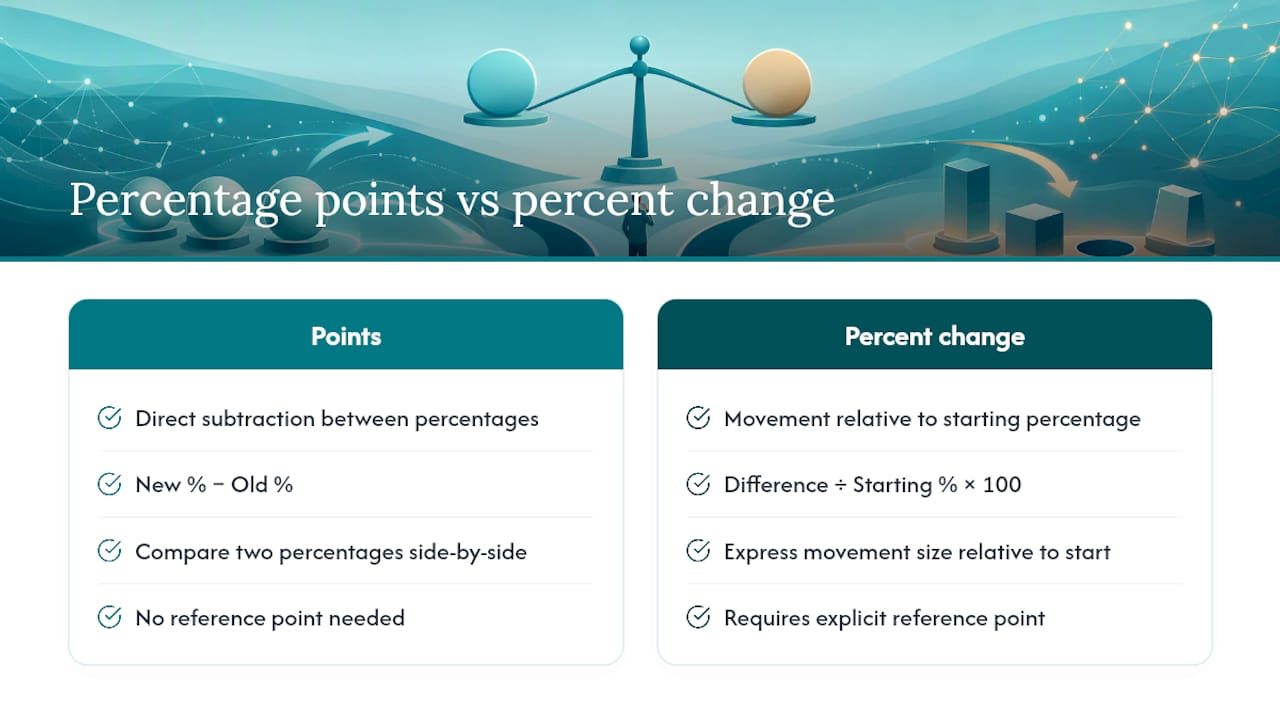
Here’s why the distinction has real consequences. Reported as percentage points, that’s a straightforward one point increase. Neither number is wrong, but they answer different questions, and a reader who doesn’t know which one they’re looking at can walk away with a badly skewed sense of scale.
The same trap applies to unemployment figures. Percent change requires an explicit reference point, and the same absolute movement produces different percent results depending on which value serves as the starting point, a principle Eurostat’s guidance on percentage change and percentage points lays out clearly for exactly this reason.
The practical rule: use percentage points when comparing two percentages side by side, and use percent change when you want to express how large that movement was relative to where it started.
Percentages in Statistics and Probability
Percentiles and probabilities both lean on the same core percentage formula, just applied to ranked data or to likelihood instead of a simple part-to-whole ratio. A percentile tells you what percentage of a data set falls below a given value.
Probability expressed as a percentage works the same way arithmetic does everywhere else in this article: divide favorable outcomes by total possible outcomes, then multiply by 100. That’s the identical part-over-whole structure from the core formula, just relabeled for a different context.
Statistical reporting also leans heavily on percent change and percentage points, especially when comparing survey results, poll numbers, or year-over-year data sets.
Where percentages get genuinely tricky in statistics is in compounding across multiple probabilities, or in confusing a percentile rank with a percentage score. Those are two separate calculations answering two separate questions: one describes raw performance, the other describes standing relative to peers.
Compound Interest: Percentages That Multiply on Themselves
Compound interest applies the percentage formula repeatedly, letting each period’s growth become the base for the next period’s calculation. The standard formula is A = P(1 + r/n)^(nt), where P is the principal, r is the annual interest rate as a decimal, n is the number of compounding periods per year, and t is the number of years.
The critical difference from simple interest is that compound interest recalculates the percentage against a growing base each time, rather than always against the original principal. That gap between $1,102.50 and $1,100 looks tiny over one year, but it widens substantially over decades, which is the entire reason compound growth gets so much attention in retirement and savings planning.
Each step of a compound interest calculation is still just the core percentage formula: part = (percent ÷ 100) × whole, applied over and over with a shifting whole. Getting the compounding frequency right matters just as much as getting the rate right. This article sticks to general math explanation rather than financial guidance, so treat any real savings or loan decision as a matter for your own bank statement or a financial professional, not a blog post formula.
Percentage Composition in Chemistry and Nutrition Labels
Percentage composition in chemistry describes what fraction of a compound’s total mass comes from each individual element, calculated with the same part-over-whole formula used everywhere else in this article.
Nutrition labels use an adapted version of the same idea, most visibly in the “% Daily Value” column. That figure represents what percentage of a recommended daily nutrient intake a single serving provides, calculated as (amount in the serving ÷ recommended daily amount) × 100.
That’s the identical calculation from the very first formula in this article, just applied to grams of fruit instead of dollars or quiz scores. Whether you’re balancing a chemical equation or reading a cereal box, the percentage math never changes. Only the labels on the numbers do.
Check Your Percentage Math With GizmoBench
Working through the formulas by hand builds the intuition, but double-checking a result before you rely on it for a bill split, a grade calculation, or a discount is worth the ten extra seconds. GizmoBench’s browser-based percentage calculator handles percent-of-a-number, percent change, and reverse-percentage problems, and it runs entirely in your browser with no account, no upload, and no software to install, matching the privacy-by-default approach across GizmoBench’s catalog.
If your problem involves fractions or proportions alongside percentages, the ratio calculator simplifies ratios and solves for a missing term, which pairs naturally with percent-to-fraction conversions. Both tools sit inside the broader everyday tools collection, where a unit converter, age calculator, and several other quick calculators are ready whenever a practical numbers problem shows up in the middle of your day. Open the percentage calculator, plug in your numbers, and confirm your answer before you act on it.
Sources
This article draws on the percentage basics chapter from an open college mathematics textbook, BBC Bitesize’s percentage guide, a university percent equation worksheet, and a percent change explainer for denominator guidance.
- Section PF.1 – Percentage basics and applications involving percentages – College Mathematics
- The Basic Percent Equation
- Calculate percentages - Microsoft Support
FAQ
How much is 20% out of 70?
You can verify it with the 1% method: 70 ÷ 100 = 0.7, then 0.7 × 20 = 14, confirming the same result.
How do I calculate a percentage of a number?
Multiply the whole by the percent expressed as a decimal: percentage of a number = (percent ÷ 100) × whole. For a fast check on any result, try GizmoBench’s percentage calculator, which runs the same formula instantly in your browser.
What is 20% out of 45?
Dividing 9 by 45 and multiplying by 100 returns 20%, which confirms the calculation.
What’s the difference between percentage points and percent change?
Percentage points measure a direct subtraction between two percentages, while percent change measures that same movement relative to the original percentage. A move from 40% to 50% is 10 percentage points but a 25% relative percent change.
Why does my percent change calculation give a different answer than expected?
The most common cause is dividing by the new value instead of the original value. Percent change always uses the original, starting value as the denominator, never the ending value.