GizmoBench guides
720 vs 120: A Student's Quick Permutations vs Combinations Test

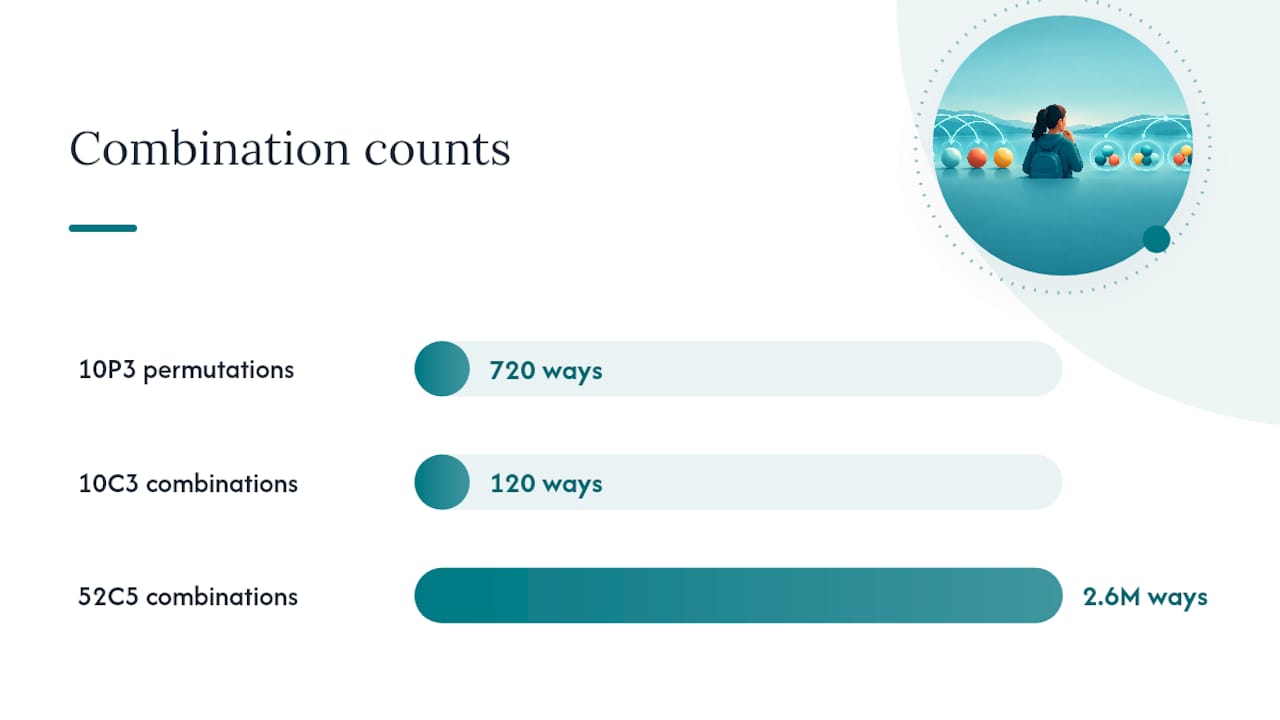
Use permutations when order matters and combinations when it doesn’t. Ranking three runners for gold, silver, and bronze from a field of ten is a permutation problem with 720 possible outcomes. Choosing three runners for a relay team from the same field of ten is a combination problem with only 120 possible groups. Same numbers, same pool, six times fewer outcomes once order stops counting.
TL;DR:
- Permutation counts differ vastly from combinations when order matters, such as ranking medals or assigning roles, with permutation outcomes growing factorially.
- The key difference is that permutation formulas account for ordered arrangements, while combination formulas count unordered selections, dividing by factorials to remove duplicate orderings.
- Mistakes typically occur by misapplying the formulas: overcounting when disregarding order or undercounting when roles are distinct, and confusion about whether repetition is allowed.
- Small, memorable edge cases such as choosing zero or one item help verify calculations, with factorial-based formulas ensuring accuracy across diverse combinatorial problems.
Table of Contents
- Permutations: Counting Ordered Arrangements
- Combinations: Counting Unordered Selections
- The Order Test: A Quick Decision Checklist
- Calculation Shortcuts and Edge Cases Worth Memorizing
- Worked Examples: P(10,3) vs C(10,3) Side by Side
- Where Students Lose Points: Mistakes and Memory Tricks
- Compute It Instantly With GizmoBench
- Sources
- FAQ
Permutations: Counting Ordered Arrangements
A permutation is an ordered arrangement of items. Swap the order and you get a different outcome, which is why medal ceremonies, race rankings, and PIN codes are permutation problems.
The formula depends on factorial notation. “$n!$” (read “$n$ factorial”) means multiplying $n$ by every whole number below it down to 1, so $5! = 5 \times 4 \times 3 \times 2 \times 1 = 120$. Factorials grow fast, which is why calculators matter once $n$ climbs past 10 or so.

The permutation formula for choosing and arranging $r$ items from a set of $n$ is:
$$P(n,r) = \frac{n!}{(n-r)!}$$
The logic is simple: there are $n$ choices for the first position, $n-1$ for the second, and so on for $r$ positions. Dividing by $(n-r)!$ trims off the unused tail of the factorial. Britannica frames this as the standard definition of an ordered arrangement, and it’s the version you’ll see in nearly every textbook.
- Basic permutation: Arranging 5 books on a shelf uses all 5 slots, so $P(5,5) = 5! = 120$.
- Partial permutation: Awarding gold, silver, and bronze among 10 sprinters gives $P(10,3) = 720$.
- Permutation with repetition: When items can repeat, like digits in a passcode, the count becomes $n^r$ instead. A 4-digit code from digits 0 through 9 has $10^4 = 10{,}000$ possibilities.
Pro Tip: If a word problem mentions ranks, positions, medals, or seating order, you’re almost certainly looking at a permutation.
Combinations: Counting Unordered Selections
A combination counts how many ways you can select $r$ items from $n$ when the order of selection doesn’t matter. Pick a committee of three from ten candidates, and swapping the names around inside that group of three doesn’t create a new committee.
The combinations formula is:
$$C(n,r) = \frac{n!}{r!(n-r)!}$$
That extra $r!$ in the denominator is the key difference from the permutation formula, and it’s not arbitrary. Every combination of $r$ items can be arranged in $r!$ different orders, so $P(n,r) = C(n,r) \times r!$. Divide the permutation count by $r!$ and you strip out every duplicate ordering, landing on the combination count. This relationship is laid out clearly in LibreTexts’ combinatorics module, which walks through the derivation step by step.
The gap between the two formulas is not small. Choosing 3 items from a pool of 10 produces 720 permutations but only 120 combinations, a sixfold difference driven entirely by the $r!$ term.
- Committee selection: Picking 3 members from 10 candidates, with no ranked roles, uses $C(10,3) = 120$.
- Poker hands: A 5-card hand from a 52-card deck has $C(52,5) = 2{,}598{,}960$ possible combinations, since a hand’s value doesn’t depend on the order the cards were dealt.
- Combinations with repetition: When you can select the same item more than once (like scoops of ice cream from a limited set of flavors), the formula becomes $C(n+r-1, r)$, sometimes called “stars and bars” counting.
Lottery draws, card hands, and committee formations are the classic combination examples cited in Math Is Fun’s breakdown, and the pattern holds across all of them: the group matters, not the sequence it was assembled in.
The Order Test: A Quick Decision Checklist
The one question that resolves almost every classification problem: would rearranging the selected items change the outcome? If yes, it’s a permutation. If no, it’s a combination.
Run through this checklist when a word problem is ambiguous:
- Does the problem assign distinct roles, ranks, or positions? That signals a permutation.
- Would two different orderings of the same group count as the same result? That signals a combination.
- Can the same item be picked more than once? If so, you need a repetition variant of either formula.
Three quick classification drills:
- Assigning class president, vice president, and treasurer from 8 students — permutation, because the roles differ.
- Choosing 4 students for a group project from 8 students — combination, because the group is unordered.
- Setting a 3-digit bike lock code — permutation with repetition, because order matters and digits can repeat.
Calculation Shortcuts and Edge Cases Worth Memorizing
Computing $P(n,r)$ or $C(n,r)$ by hand gets easier once you stop expanding the full factorial. Write $n!/(n-r)!$ as a shrinking product instead: $P(10,3)$ is just $10 \times 9 \times 8$, not $10!$ divided by $7!$ in full.
A few edge cases are worth memorizing because they show up constantly on exams:
- $C(n,0) = 1$ — there’s exactly one way to choose nothing.
- $C(n,1) = n$ — choosing one item from $n$ gives $n$ options, obviously.
- $P(n,0) = 1$ — arranging zero items has exactly one (empty) outcome.
These edge cases are useful sanity checks noted in the LibreTexts derivation: plug in $r=0$ or $r=1$ to any formula you’ve derived, and if it doesn’t return these values, you made an algebra mistake.
Pro Tip: For repetition problems, ask whether items can repeat first, then whether order matters second. That two-step filter sorts every case into one of the four formulas: $P(n,r)$, $C(n,r)$, $n^r$, or $C(n+r-1,r)$.
Once $n$ or $r$ gets large, hand calculation turns into a math homework grind rather than a conceptual exercise. A ratio calculator can help you double check the canceled factorial products before you commit to a final answer.
Worked Examples: P(10,3) vs C(10,3) Side by Side
Nothing clarifies the distinction faster than running the same numbers through both formulas.
- Permutation, $P(10,3)$: Multiply $10 \times 9 \times 8 = 720$. This counts every way to award gold, silver, and bronze among 10 racers, where each position matters.
- Combination, $C(10,3)$: Take that same 720 and divide by $3! = 6$, giving $720 / 6 = 120$. This counts every way to pick 3 racers for a relay team, with no ranking inside the group.
- Lottery draw: Picking 6 numbers from 49 without regard to order (standard lottery math) is a combination problem, confirmed by Math Is Fun’s treatment of everyday combination examples. The order the balls are drawn in doesn’t change whether you match the winning set.
- 3-digit lock: A combination lock with digits 0 to 9 and 3 wheels, where repeats are allowed and order absolutely matters, has $10^3 = 1{,}000$ possible codes. This is a permutation with repetition despite the misleading name on the lock itself.
The 720-versus-120 gap in the P(10,3) versus C(10,3) comparison is the cleanest illustration of the $r!$ relationship in the entire topic, and it’s worth memorizing as a reference pair.
Where Students Lose Points: Mistakes and Memory Tricks
The most common error is treating a permutation problem as a combination, usually because the word “combination” gets used loosely in everyday speech, including on locks that are technically permutation devices.
- Overcounting: Forgetting to divide by $r!$ when order truly doesn’t matter, which inflates the answer by a factor of $r!$.
- Undercounting: Dividing by $r!$ when roles or ranks are actually distinct, which shrinks a permutation answer down to the wrong combination count.
- Repetition blindness: Applying the no-repetition formula to a problem that explicitly allows repeats, like PINs or lottery balls drawn with replacement.
Two mnemonics fix most of this: Permutation = Position (something gets placed in an order), and Combination = Collect (you’re just gathering a group). Before submitting an answer, label the items, ask the order question out loud, and test the formula on a tiny case like $n=3, r=2$ to confirm it matches what you’d count by hand.
Compute It Instantly With GizmoBench
Working through factorials by hand is good practice, but it’s slow once $n$ climbs into the double digits, and a single arithmetic slip on a 720 or 2,598,960 calculation is easy to make and hard to spot. You can check a permutation or combination answer directly in your browser, with no account required or uploads needed, so verification is immediate.
If your problem involves random sampling or drawing numbers to test a lottery-style scenario, the random number generator lets you simulate draws directly. For the arithmetic itself, the ratio calculator helps verify the canceled factorial products from the shortcut method covered earlier. Students juggling other coursework math, from percentage problems to unit conversions, will find the full set of everyday calculators useful for the same reason: quick verification without creating an account or installing anything. Try running your next P(n,r) or C(n,r) problem through one of these tools before you turn in the homework.
Sources
- Permutation | Britannica
- Combinations and Permutations | Math is Fun
- Permutations and Combinations | LibreTexts
FAQ
What Is the Difference Between Combinations and Permutations?
Permutations count ordered arrangements, so rearranging the items creates a new outcome. Combinations count unordered selections, so the same group counts once no matter how it was assembled, which is why P(10,3) equals 720 while C(10,3) equals only 120.
How Do You Know if a Problem Is a Combination or a Permutation?
Ask whether rearranging the chosen items would change the result. If yes, it’s a permutation; if the group is the same regardless of order, it’s a combination.
What Is the Difference Between P and C in Permutation and Combination Formulas?
$P(n,r) = n!/(n-r)!$ counts ordered arrangements, while $C(n,r) = n!/(r!(n-r)!)$ counts unordered groups. The extra $r!$ in the combination formula removes duplicate orderings, since each group of r items can be arranged r! different ways.
Is the Lottery a Combination or a Permutation?
The lottery is a combination problem, because the order the winning numbers are drawn in doesn’t affect whether your ticket matches. Picking 6 numbers from a larger pool without regard to draw order is a textbook combination example.
Why Is a Combination Lock Actually a Permutation?
Despite the name, a combination lock requires the correct digits in the correct order, which makes it a permutation with repetition rather than a true combination. A 3-digit lock using digits 0 through 9 allows $10^3 = 1{,}000$ possible codes, since repeats are allowed and sequence matters.