GizmoBench guides
Avoid Unit Errors: BMI Formula in 3 Clear Steps

The BMI formula is weight in kilograms divided by height in meters squared, or BMI = kg / m². It produces a single number that screens where your weight falls relative to your height, nothing more. The U.S. customary version swaps in pounds and inches with a conversion constant of 703.
TL;DR:
- Most errors in BMI calculation stem from mixing measurement units or incorrectly squaring height without converting to meters in metric calculations.
- The adult BMI categories range from under 18.5 indicating underweight to over 40 signaling severe obesity, with specific subranges used clinically.
- For children and teens, BMI interpretation relies on age- and sex-specific percentiles, not fixed numeric thresholds, to account for growth patterns.
- BMI is a screening tool that does not distinguish muscle from fat or account for body fat distribution, so it should be combined with other assessments like body fat percentage.
- Using automated tools and consistent measurement practices reduces errors and provides a fuller understanding of body composition beyond raw BMI numbers.
Table of Contents
- The BMI Formula in Metric and U.S. Customary Units
- How to Calculate BMI Step by Step
- What Do the Adult BMI Categories Mean?
- BMI for Children and Teens Works Differently
- Where the BMI Formula Falls Short
- Getting Accurate Height and Weight Inputs
- Skip the Manual Math With GizmoBench’s Calculators
- Where These Numbers Come From
- Sources
- FAQ
The BMI Formula in Metric and U.S. Customary Units
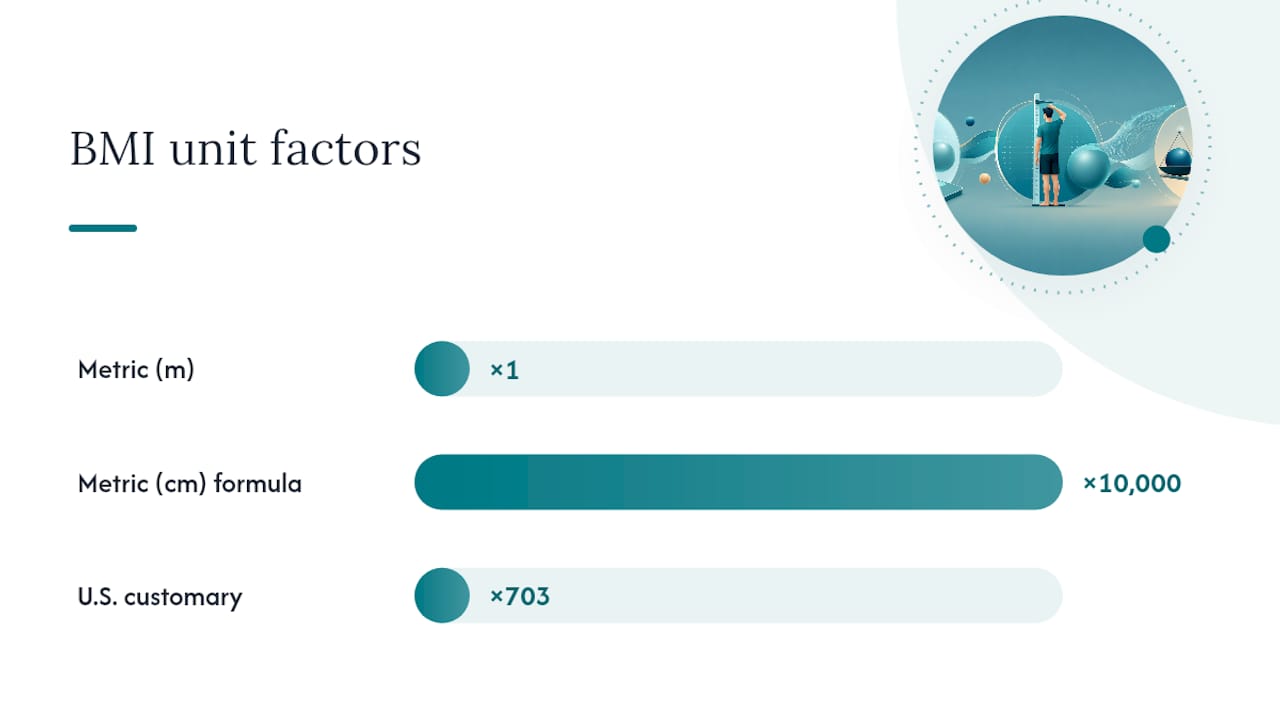
The metric formula is straightforward: divide weight in kilograms by height in meters, squared. If your height is easier to measure in centimeters, there’s an alternate version that skips the meter conversion:
- Metric (meters): BMI = weight (kg) / [height (m)]²
- Metric (centimeters): BMI = [weight (kg) / height (cm) / height (cm)] × 10,000
- U.S. customary: BMI = weight (lb) / [height (in)]² × 703
That 703 constant isn’t arbitrary. It’s a conversion factor that adjusts for the fact that pounds and inches aren’t metric units, effectively rescaling the imperial inputs so they land on the same BMI scale as the kilogram/meter version. Without it, you’d get a number with no clinical meaning at all.
The most common mistake happens at the squaring step. People square the height correctly but forget to convert centimeters into meters first, which throws the whole result off by a factor of 10,000. Others mix systems entirely, plugging pounds into the metric formula or centimeters into the imperial one. Before you calculate anything, confirm every input is in the same measurement system, and use a unit converter if you’re jumping between kg/cm and lb/in.
How to Calculate BMI Step by Step
A metric example makes the mechanics clear. Say someone weighs 70 kg and stands 1.75 m tall.
- Square the height: 1.75 × 1.75 = 3.0625
- Divide weight by that result: 70 / 3.0625 = 22.86
- Round to one decimal place: BMI = 22.9
Using the centimeters version with the same person (175 cm), the math looks like this: 70 / 175 / 175 = 0.002286, then × 10,000 = 22.86. Same answer, different route.
Now the U.S. customary version, following the worked example style MedlinePlus uses for pounds and inches. Say someone weighs 154 lb and is 69 inches tall (about the metric equivalent above).
- Square the height: 69 × 69 = 4,761
- Multiply weight by 703: 154 × 703 = 108,262
- Divide: 108,262 / 4,761 = 22.74, rounded to 22.7
The two systems land within a decimal point of each other once you account for rounding, which is a useful sanity check. If your metric and imperial calculations for the same person differ by more than half a point, you’ve likely made a conversion error somewhere.
What Do the Adult BMI Categories Mean?
For adults age 20 and older, CDC-defined thresholds sort BMI results into five bands:
- Underweight: below 18.5
- Healthy weight: 18.5 to 24.9
- Overweight: 25.0 to 29.9
- Obesity, Class 1: 30.0 to 34.9
- Obesity, Class 2: 35.0 to 39.9
- Obesity, Class 3: 40.0 and above
The subclassification matters clinically. Class 1, 2, and 3 obesity aren’t just labels stacked on top of “obese.” Clinicians use these subranges to gauge health risk and decide how aggressively to pursue further evaluation or intervention.
A BMI of 22.9, like the metric example above, sits comfortably in the healthy weight range. A BMI of 26, which comes up often in people’s own calculations, falls just above the healthy cutoff and into the lower end of overweight. That’s not an alarming number on its own. It’s a screening flag that may or may not warrant a closer look, depending on the rest of someone’s health picture.
These ranges apply specifically to adults. Applying them to a 15 year old or a 65 year old without context misses important nuance covered below.
BMI for Children and Teens Works Differently
Applying the adult thresholds above to a child is a common and meaningful error. For ages 2 through 19, BMI is interpreted using age and sex-specific percentiles rather than fixed numeric cutoffs, because a healthy BMI shifts constantly as kids grow.
- A child’s BMI is plotted against a percentile curve for their exact age and sex.
- Obesity in this age range is defined as a BMI at or above the 95th percentile for age and sex, not a flat number like 30.
- CDC publishes separate child and teen BMI calculators specifically to avoid the confusion of using adult math on a growing body.
If you’re calculating BMI for a child, skip the adult formula’s interpretation step entirely and use a percentile-based tool instead.
Where the BMI Formula Falls Short
BMI is a population-level screening tool, not a diagnostic measurement. The NHLBI is explicit about this: the formula estimates weight relative to height, and it does not distinguish muscle from fat, bone density, or where fat sits on the body.
That gap shows up in predictable places:
- A muscular athlete can post a BMI in the “overweight” range despite low body fat, simply because muscle weighs more than fat.
- Older adults can carry a “healthy” BMI while losing significant muscle mass, a pattern known as sarcopenia, which BMI alone won’t catch.
- Body fat distribution varies across population groups in ways a single height/weight ratio can’t capture.
This is why BMI works best as one data point rather than a verdict. Waist circumference, waist to hip ratio, and body fat percentage (sometimes estimated through methods like the Navy body fat method) all give a fuller picture when combined with BMI.
Pro Tip: If your BMI result surprises you, or sits close to a category boundary, don’t stop at the number. A body fat percentage estimate adds context that BMI alone can’t provide.

Getting Accurate Height and Weight Inputs
Every BMI calculation is only as good as the numbers you feed it. A few habits cut down on avoidable errors:
- Weigh yourself at a consistent time of day, ideally in the morning before eating, without shoes or heavy clothing.
- Measure height standing straight against a flat surface, without shoes, and record it to the nearest tenth of a unit.
- Double-check which unit system you’re working in before you calculate. Kilograms and meters, or pounds and inches. Never mix them.
- Always square the height, not the weight, and confirm that step before dividing.
If you want a quick validation, run the numbers through both the metric and imperial formulas. They should land within a decimal point of each other once rounded, which catches most unit mismatches before they become a wrong result.
Skip the Manual Math With GizmoBench’s Calculators
Doing this math by hand works fine once. Doing it repeatedly, across unit systems, is where transcription errors creep in. GizmoBench’s Body Fat Percentage Calculator runs BMI alongside other body composition estimates directly in your browser, so you get the full picture instead of a single isolated number. If you’re converting between kilograms, pounds, centimeters, and inches before you calculate anything, the unit converter handles that step automatically instead of leaving you to do the arithmetic by hand.
Both tools run entirely in your browser with no account needed and no file uploads required, which matters if you’d rather not create a login just to check a number. Core functions on the site are free to use; check the tool page directly for the full list of features available. If you’re double-checking a calculation across metric and imperial systems, the ratio calculator is a fast way to verify your cross-check adds up. Start with the body fat calculator if you want your BMI result placed in a broader context rather than standing alone.
Where These Numbers Come From
The formulas and conversion constant in this article come from CDC’s growth chart training materials, which also cover common measurement errors. Adult category thresholds are drawn from CDC’s adult BMI categories page, while the worked pounds-and-inches example follows the structure used by MedlinePlus. Context on BMI’s limitations as a screening tool comes from the NHLBI.
This article is general information, not a substitute for advice from a qualified doctor. Consult a qualified healthcare professional about your own circumstances before acting on anything here.
Sources
- Calculating BMI | Growth Chart Training | CDC
- Body mass index: MedlinePlus Medical Encyclopedia
- Calculate your BMI | NHLBI
FAQ
How do you calculate BMI?
Divide your weight in kilograms by your height in meters squared. If you’re working in pounds and inches, divide weight by height squared, then multiply by 703.
What is a normal BMI?
A BMI between 18.5 and 24.9 falls in the healthy weight category for adults age 20 and older.
What is the correct BMI for my height and age?
For adults, the same 18.5 to 24.9 healthy range applies regardless of age. For children and teens age 2 to 19, there’s no single “correct” number. Interpretation depends on age and sex-specific percentiles rather than fixed cutoffs.
Is a BMI of 26 chubby?
A BMI of 26 falls just above the healthy range and into the lower end of the overweight category (25.0 to 29.9). It’s a screening flag worth noting, not a diagnosis, since BMI alone doesn’t account for muscle mass or body composition.