GizmoBench guides
7 Bags, 32 Gallons: DIY Concrete Mix Ratios That Nail 3,000 PSI
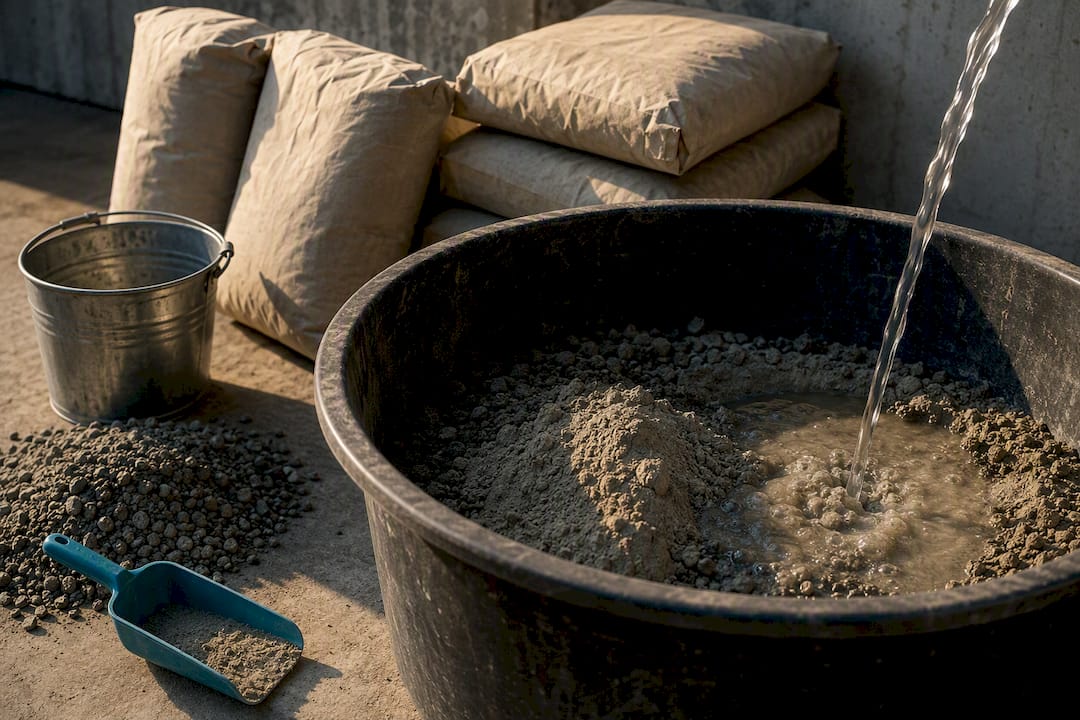
For most DIY slabs, footings, and patios, a 1:2:3 cement to sand to gravel ratio (by volume) gets you around 3,000 PSI concrete, which handles typical residential loads. For lighter, nonstructural fill work, 1:2:4 stretches your cement further. Whichever ratio you pick, the water you add matters more than the ratio itself: too much water weakens the pour no matter how carefully you measured the dry ingredients. Below, you’ll find bag counts and volumes so you’re not guessing on pour day.
TL;DR:
- Using a 1:2:3 ratio typically yields 3,000 PSI concrete suitable for most residential slabs and patios, but overwatering significantly reduces strength.
- For load-bearing projects like driveways or footings, consider ratios such as 1:1.75:3 or higher PSI mixes, and always confirm local code requirements.
- Expect roughly 6 to 6.5 bags of 94-pound cement or about 7.5 to 8 bags of 80-pound cement for a cubic yard of concrete, with water ratios around 0.45 to 0.5.
- Proper curing involves keeping concrete moist for 3 to 5 days, as excess water added during mixing can reduce final strength by up to 40 percent.
- Always round up material orders using online calculators to account for shrinkage and moisture, and add a little extra water gradually during mixing to maintain strength.
Table of Contents
- What Does a Concrete Mix Ratio Actually Mean?
- How Do I Pick the Right Ratio and PSI for My Project?
- How Much Concrete Do I Need? Bags, Volume, and Water
- How Do You Mix Concrete by Hand or Machine?
- Why Does Concrete Crack, and How Do You Cure It Right?
- Skip the Guesswork With Online Calculators
- Sources
- FAQ
What Does a Concrete Mix Ratio Actually Mean?
A concrete mix ratio expresses the volume of cement to sand to coarse aggregate (gravel or crushed stone) in a batch. A 1:2:3 ratio means one part cement, two parts sand, three parts aggregate, measured by volume rather than weight. Most DIY guides and calculators default to volume batching because it’s fast on a job site. You don’t need a scale. A five-gallon bucket used as a consistent scoop works fine for small pours.
These are called nominal mixes, meaning they’re standardized ratios chosen for general use rather than engineered for a specific project. Here’s how the common ones break down:
- 1:1:2 — dense, high-strength mix for heavy footings or structural columns
- 1:1.5:3 — solid choice for driveways, garage slabs, and areas with vehicle traffic
- 1:2:3 — the workhorse ratio for patios, sidewalks, and general slab work
- 1:2:4 — leaner mix for fence post footings, non-load-bearing fill, and backfill
- 1:3:6 — lean mix for mass concrete, blinding layers, or non-structural bedding
Nominal mixes work fine for the projects most homeowners tackle. But once you’re pouring anything load-bearing at a larger scale, engineers switch to design mixes based on mass (weight) batching, since bulk density differences between materials can throw off strength calculations that volume ratios can’t catch. That’s a job for a structural engineer, not a wheelbarrow and a shovel, as MixDesignCalc’s batching guidance points out.
How Do I Pick the Right Ratio and PSI for My Project?
Match your ratio to the job’s load demands, not the strongest mix you can find. Overbuilding wastes cement and money; underbuilding cracks under a car tire. Here’s a practical mapping between common projects, target PSI, and the ratio that gets you there:
- Patios and walkways — 2,500 to 3,000 PSI, use 1:2:4 or 1:2:3
- Standard slabs and sidewalks — 3,000 PSI, use 1:2:3
- Driveways and garage floors — 3,500 to 4,000 PSI, use 1:1.75:3 to 1:1.5:3
- Footings under heavy structures — 4,000 PSI or higher, use 1:1.5:3 and confirm against local code
- Fence posts and non-structural fill — under 2,500 PSI, use 1:2:4 or leaner
Concrete calculators and mix guides commonly list 1:2:3 as the general-purpose standard for roughly 3,000 PSI flatwork, which is why it shows up so often in DIY instructions. If your project touches a load-bearing wall, a foundation, or anything a building inspector will look at, don’t freehand the ratio. Local codes typically specify a minimum PSI, and some jurisdictions require documentation from a licensed engineer for structural pours. When in doubt about heavy vehicle traffic (think delivery trucks, not just your sedan), round up to the next PSI tier rather than the minimum that technically qualifies.
How Much Concrete Do I Need? Bags, Volume, and Water
Dry ingredients shrink when mixed and compacted; wet concrete yields less volume than the sum of its dry parts. Calculators typically use a yield factor around 0.67 to account for this, which is why you always round your material order up, not down.
Here’s how that plays out in two common scenarios:
- One cubic yard at a 1:2:3 ratio. You’ll need roughly 6 to 6.5 bags of 94-lb cement (or about 7.5 to 8 bags of the more common 80-lb bags), plus around 0.5 cubic yards of sand and 0.75 cubic yards of gravel. For water, target a 0.45 to 0.5 water-cement (W/C) ratio, which lands around 30 to 35 gallons for that batch, adjusted for sand moisture.
- One 80-lb bag for a small repair. A single bag yields about 0.6 cubic feet of finished concrete, enough for a small fence post footing or patch. Start with roughly 3 quarts of water, per Quikrete’s hand-mixing guidance, and add more only in small splashes until the mix holds together without pooling.
If you’re staring at a slab layout wondering how those numbers scale to your actual pour, plug your dimensions into a square footage calculator first, then convert that footprint and thickness into cubic yards with a volume calculator before you commit to a bag count.
How Do You Mix Concrete by Hand or Machine?
Wear safety glasses, gloves, and a dust mask when handling dry cement. Wet concrete is caustic enough to irritate skin on contact, so don’t mix barehanded even for a small batch. You’ll also want a mixing tub or wheelbarrow, a hoe or shovel, and a bucket for measured water additions.
- Combine the dry cement, sand, and aggregate first, mixing until the color is uniform with no visible streaks of gray cement.
- Form a hollow in the center of the dry pile and add about two-thirds of your measured water.
- Fold the dry material into the water gradually, working from the edges inward.
- Add the remaining water in small amounts, mixing continuously for 3 to 5 minutes, until you reach a workable consistency.
- If using a portable mixer, load dry ingredients and roughly half the water first, then add the rest gradually while the drum turns, rather than dumping it all in at once.
The consistency you’re after looks like thick oatmeal or stiff peanut butter, not pancake batter. A squeeze test works well here: grab a handful with a gloved hand, and it should hold its shape without crumbling apart or oozing water between your fingers.
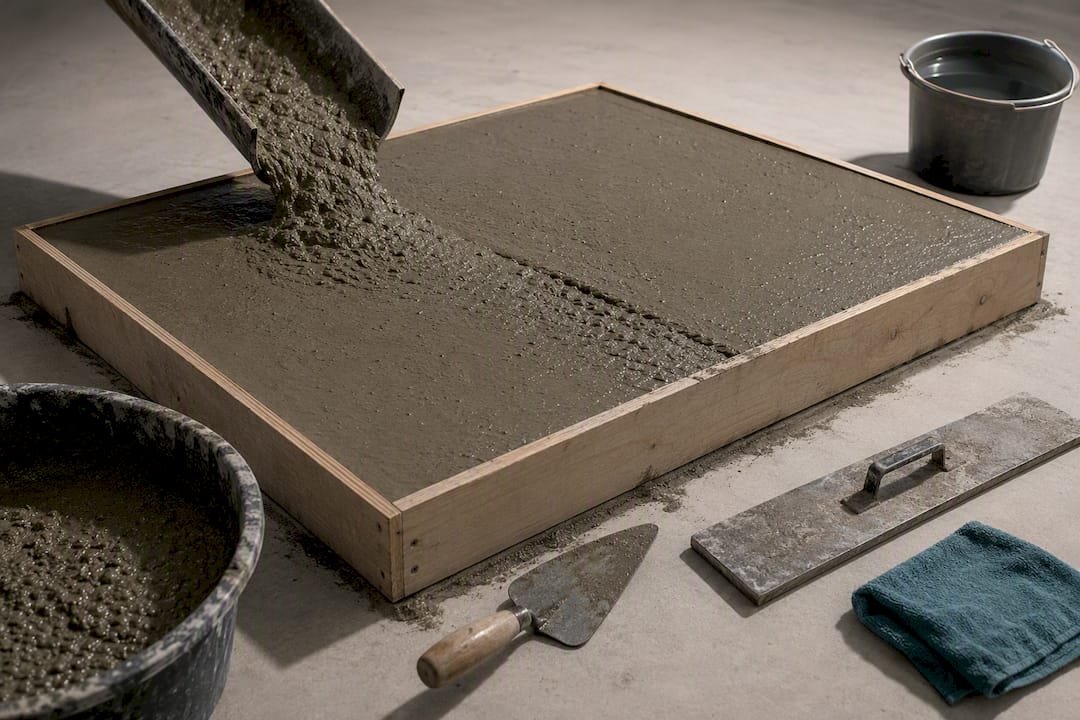
Pro Tip: Have your forms, tools, and helpers ready before you start mixing. Working time runs roughly half an hour to less than an hour once water hits the cement, and stopping mid-pour risks a cold joint where the two pours won’t bond properly.
Why Does Concrete Crack, and How Do You Cure It Right?
Keep fresh concrete moist for 3 to 5 days after pouring for most residential slabs and footings. This slows the drying process so the cement has time to fully hydrate, which is what prevents premature cracking and helps the pour reach its target strength. Structural elements like footings under heavy loads often benefit from longer curing, closer to a week, with regular misting or a covering to hold moisture in.
Water is the single biggest variable you control. Adding just one extra quart of water to an 80-lb bag can reduce final strength by up to 40 percent, according to Quikrete’s own mix guidance. That’s not a rounding error. It’s the difference between a driveway that lasts decades and one that spalls within a few winters.
Common mistakes that undercut an otherwise good pour:
- Overwatering to make mixing easier — resist it; add water in small increments and re-check consistency each time
- Skipping the sand moisture check — damp sand can already carry several gallons of water into the mix, so account for it before adding more
- Undermixing — streaky, uneven color usually means pockets of weak concrete are hiding in the batch
- Running out mid-pour — buy one extra 80-lb bag beyond your calculated total; a leftover bag is a far smaller problem than a half-finished slab
Skip the Guesswork With Online Calculators
Getting from “I want a 1:2:3 mix” to “I need 7 bags and 32 gallons of water” is where most DIY math goes sideways. Browser-based tools can handle that conversion without asking for an account or a software download.
- Start with the area calculator if your slab isn’t a simple rectangle.
- Feed that footprint into the volume calculator with your pour thickness to get cubic feet or cubic yards.
- Use the ratio calculator to scale your chosen mix ratio to that exact volume.
- Run any gallon-to-liter or pound-to-kilogram conversions through the unit converter if you’re working from metric packaging.
Round every result up, never down, and adjust for wet sand before you finalize your water total. For anything structural, cross-check the output against your local building code or a licensed contractor.
Sources
- The importance of water-cement ratio in concrete countertop mix design
- Mixing concrete – hand mixing | QUIKRETE
- Mix Ratios | MixDesignCalc
FAQ
What Is the Strongest Concrete Mix Ratio?
A 1:1:2 ratio (cement to sand to aggregate) produces the densest, highest-strength nominal mix, often used for structural columns and heavy footings, but it also costs more cement per batch than lighter ratios like 1:2:3.
Is a 4:1 Ratio Good for Concrete?
A 4:1 ratio (4 parts aggregate blend to 1 part cement) is unusually lean and isn’t a standard nominal mix; most DIY and industry references favor ratios like 1:2:3 or 1:2:4 for reliable strength in typical slab and footing work.
Is a 3:1 Ratio a Strong Concrete Mix?
A straight 3:1 sand-to-cement or aggregate-to-cement ratio isn’t one of the common nominal mixes used for structural concrete; standard references use three-number ratios like 1:2:3 that separately account for sand and gravel proportions.
What Is the 90-Minute Rule for Concrete?
Ready-mix trucks typically must discharge concrete within roughly 30 to 45 minutes of batching to avoid the mix stiffening past a workable state, though hand-mixed batches on a DIY job have a shorter working window of roughly 30 to 45 minutes once water is added.