GizmoBench guides
120–227 g Cups to Grams Quick Reference for Bakers
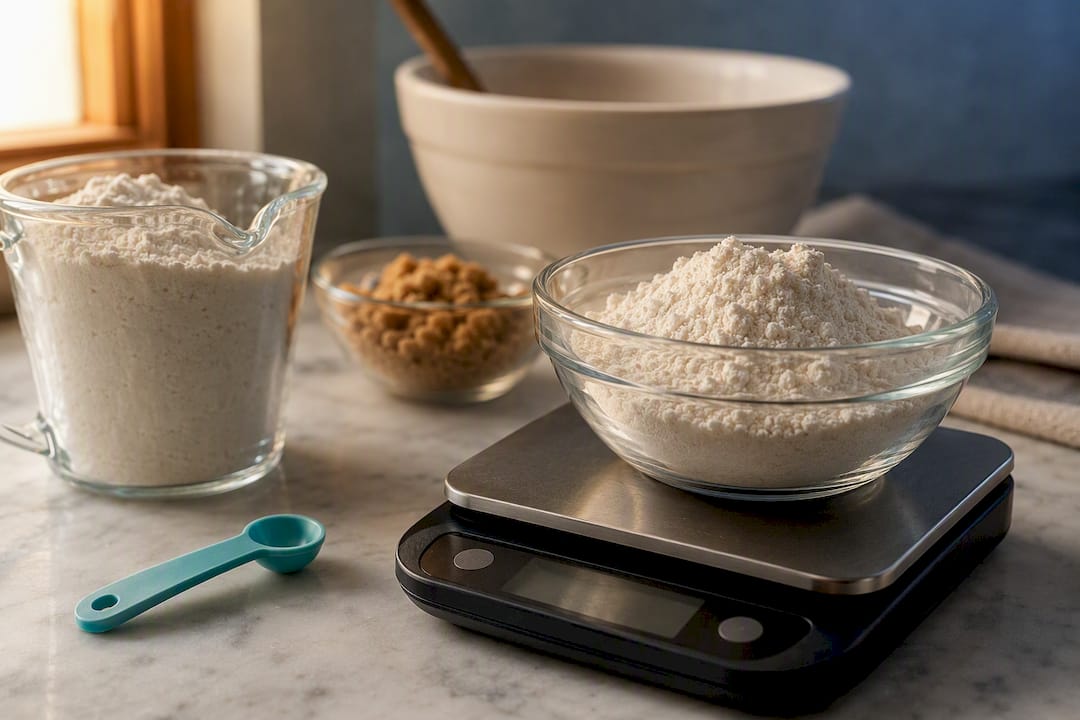
There is no single cups-to-grams number because a cup measures volume, not weight, and every ingredient packs differently into that same space. For the ingredients home bakers reach for most, the practical defaults are all-purpose flour at 120 to 125 grams per cup, granulated sugar at 200 grams, and butter at 227 grams. When a recipe’s success depends on exact ratios, weighing beats scooping every time, and a grams-to-cups converter will get you there faster than doing the math by hand.
TL;DR:
- Using weight measurements ensures more consistent results, especially for flour, where scooping can cause a 10 to 15 percent variation.
- Be aware that ingredient densities vary; for example, packed brown sugar weighs about 213 grams per cup, while sifted flour weighs roughly 114 grams per cup.
- A standard US cup holds 236.6 milliliters, which can slightly differ from a 250-milliliter metric cup used internationally, potentially affecting liquid measurements.
- Accurate sticky or powdery ingredient measurement benefits from oil coatings on cups or whisking dry ingredients before leveling to avoid weight inaccuracies.
- Using online converters like GizmoBench simplifies ingredient-specific conversions, saving time and reducing errors when adjusting recipes.
Table of Contents
- Cups to Grams Conversion Table for Common Ingredients
- Why Do Grams Per Cup Vary by Ingredient?
- Why Weighing Beats Scooping for Consistent Bakes
- What’s the Difference Between US and Metric Cup Sizes?
- How to Convert Cups to Grams: Formula and Examples
- Does Moisture Content Change a Cup-to-Gram Conversion?
- Sifted vs. Unsifted Flour: Does It Change the Gram Count?
- What Are the Most Common Cups-to-Grams Mistakes?
- How Do You Measure Sticky or Powdery Ingredients Accurately?
- Convert Any Recipe in Seconds With GizmoBench
- Sources
- FAQ
Cups to Grams Conversion Table for Common Ingredients
The table below covers the ingredients that show up in most kitchens, broken into the cup fractions bakers actually use. Values assume flour is spooned into the measuring cup and leveled off with a knife, not scooped directly from the bag, per baking technique guides. Brown sugar is measured packed, as most recipes assume.
These figures reflect commonly cited baking references and industry conversion charts, including values compiled by Doves Farm and Industry Kitchens. If your recipe specifies “scooped” or “unpacked,” expect the gram figures to run higher for flour and lower for brown sugar.
Why Do Grams Per Cup Vary by Ingredient?
Density explains almost everything here. Flour is full of tiny air pockets that compress the moment you scoop instead of spoon, which is why the same cup can hold anywhere from 120 to 140 grams depending on technique. Brown sugar behaves the opposite way. It clumps and sticks, so packing it down forces out air and pushes the weight up to roughly 213 grams per cup, well above granulated sugar’s 200 grams, even though the crystals themselves aren’t much different in size.
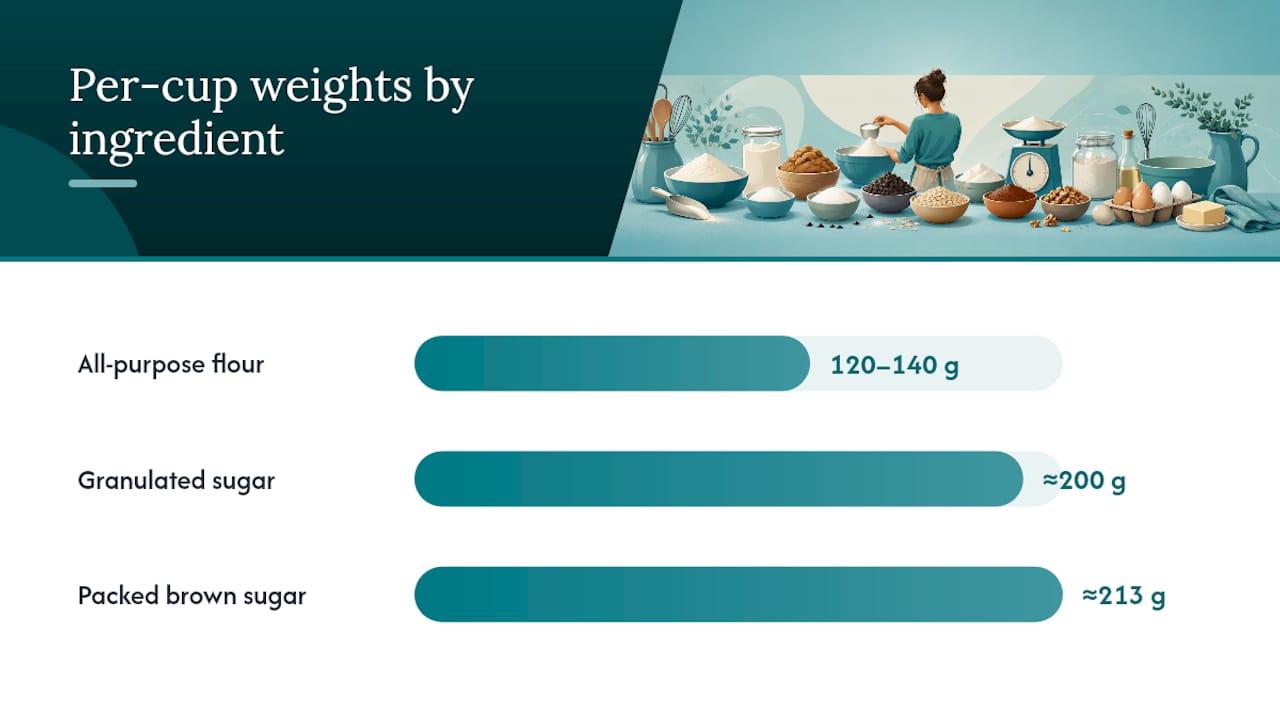
Butter is the most forgiving of the bunch because it’s a solid block, not a loose powder or granule. A standard US stick is 113 grams, so two sticks give you the 227-gram cup figure with almost no measuring error, provided you’re using the markings printed on the wrapper rather than eyeballing it.
Here’s how the most common ingredients break down in practice:
- All-purpose flour (about 120 to 125 g): Spoon into the cup, then level with a knife. Never pack it down or tap the cup.
- Bread flour (about 127 g): Slightly denser due to higher protein content and gluten structure.
- Cake flour (about 114 g): Finer milling means more air gets trapped, so it weighs less per cup.
- Granulated sugar (about 200 g): Pours evenly and needs no special technique beyond leveling the top.
- Brown sugar (about 213 g): Always pack it firmly enough that it holds the shape of the cup when turned out.
- Powdered sugar (about 120 g): Sift before measuring if it’s clumped, since compacted powdered sugar measures heavier.
Pro Tip: Calibrate your kitchen scale with a known weight, like three US quarters (about 20 grams), before a big baking session, and stick to one measuring method every time you bake the same recipe. Consistency matters more than which method you pick.
Why Weighing Beats Scooping for Consistent Bakes
Scooping flour straight from the bag compresses it, and that single habit accounts for roughly a 10 to 15 percent swing in flour weight between bakers using the same recipe. In a cake or bread formula where flour is the backbone of the structure, that swing can mean the difference between a tender crumb and a dense, gummy loaf. Weighing removes the guesswork because weight measures the exact mass, regardless of when you bake.
Statistic Callout: Spoon-and-level flour measuring consistently produces lighter, more accurate results than scooping, with published baking technique guides citing a 10 to 15 percent weight difference between the two methods.
A short routine keeps your measurements repeatable every time you bake:
- Place your bowl on the scale and press tare to zero it out.
- Weigh directly into the bowl rather than converting cups mid-recipe.
- Use the same technique (spoon-and-level or packed) every time a recipe calls for it.
- Jot down which method you used if you’re adapting an old family recipe with no notes.
What’s the Difference Between US and Metric Cup Sizes?
A US customary cup holds 236.6 milliliters, while a metric cup used in Australia, the UK, and much of Europe holds 250 milliliters, according to conversion references that track both standards. That’s roughly a 5.6 percent difference, small for a single cup but enough to throw off a layered cake if you’re scaling a recipe up.
Here’s how to tell which standard a recipe is using:
- Recipes from US sites and cookbooks default to the 236.6 mL cup.
- Recipes from Australian, British, or New Zealand sources typically use the 250 mL metric cup.
- If a recipe lists both cups and milliliters, trust the milliliter figure and ignore the cup measurement entirely.
- For liquids specifically, the cup size difference shifts weight results directly, since water measures almost exactly 1 gram per milliliter.
How to Convert Cups to Grams: Formula and Examples
The formula is simple: grams equal cups multiplied by the ingredient’s grams-per-cup value. Once you know that one number for an ingredient, you can convert any fraction a recipe throws at you.
Worked example 1: Convert 2/3 cup of all-purpose flour using 120 grams per cup.
- Set up the math: 0.667 × 120 g = 80.04 g.
- Round to a kitchen-usable figure, following NIST’s guidance on rounding only as a final step: 80 g.
Worked example 2: Convert 5/8 cup of granulated sugar using 200 grams per cup.
- Set up the math: 0.625 × 200 g = 125 g.
- No rounding needed here since the result lands on a clean number.
For recipes with several ingredients or awkward fractions like 3/8 or 7/8 cup, running each one through the GizmoBench Grams to Cups converter is faster and less error-prone than doing five separate multiplications by hand.
Does Moisture Content Change a Cup-to-Gram Conversion?
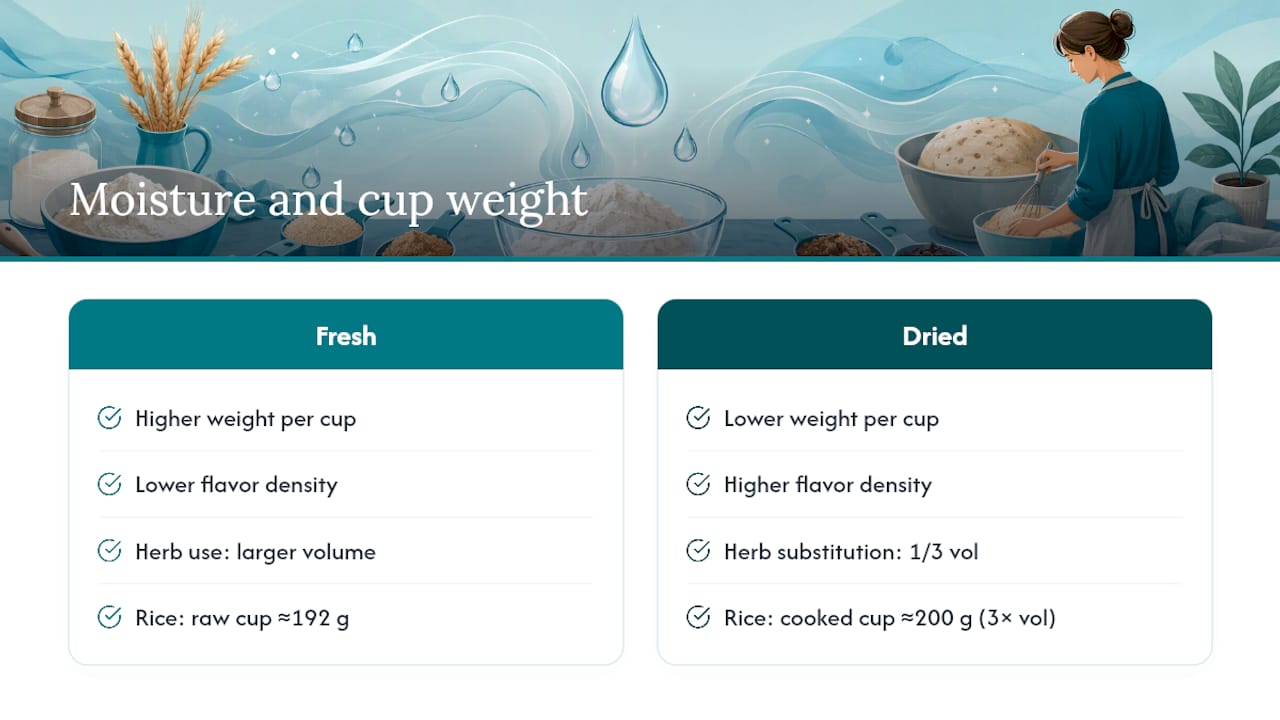
Yes, and it’s one of the most overlooked variables in recipe conversion. A cup of fresh grated carrots weighs meaningfully more than a cup of dried, shredded carrots, because water adds weight without adding volume in the same proportion once it evaporates. The same logic applies to fruit: a cup of fresh chopped apple carries far more water weight than a cup of dried apple pieces, even though both fill the same measuring cup.
This matters most with ingredients that appear in both fresh and dried form in different recipes, like coconut, cranberries, herbs, and breadcrumbs. Dried herbs are far denser in flavor per gram than fresh, which is why recipes typically call for a third of the volume when substituting dried for fresh, a ratio that has nothing to do with weight and everything to do with concentrated flavor compounds.
Grain and legume conversions carry a related trap. A cup of raw rice weighs about 192 grams, but that same cup of rice after cooking absorbs water and can weigh closer to 200 grams per cup of cooked volume, while occupying roughly three times the original space. If a recipe doesn’t specify “raw” or “cooked,” check context clues, like whether the ingredient is listed before or after a cooking step, before you weigh anything. Getting this wrong doesn’t just shift a gram or two. It can mean using a third of the rice a recipe actually needs.
Sifted vs. Unsifted Flour: Does It Change the Gram Count?
Sifting adds air to flour without adding volume of actual flour, so a cup of sifted flour weighs less than a cup of the same flour scooped straight from the bag. Older recipes, particularly ones for delicate cakes, often specify “1 cup sifted flour” precisely because that lighter, aerated cup produces a finer crumb than unsifted flour would.
The practical fix is to sidestep the ambiguity entirely by weighing. If a recipe calls for 1 cup sifted flour and you’re working from the 120-gram unsifted default in the table above, sift first, then measure, or better yet, weigh the flour, sift it separately for texture, and skip the volume measurement altogether. Weight doesn’t change based on whether the flour passed through a sifter. A gram of flour is a gram of flour, sifted or not. The confusion only exists because cups measure the space flour takes up, and sifting changes that space without changing the substance.
If you’re converting an older recipe that predates weight-based instructions, and it doesn’t specify sifted or unsifted, assume unsifted unless the recipe is for a delicate sponge or chiffon cake, where the extra lightness usually matters enough that the original author would have called it out.
What Are the Most Common Cups-to-Grams Mistakes?
The single biggest error is treating “cups to grams” as if it has one universal answer instead of an ingredient-specific one. Bakers who memorize “1 cup equals 240 grams” and apply it to flour end up with double the correct weight, since flour’s actual figure sits closer to 120 grams.
A second common mistake is mixing measuring methods within the same recipe: spooning the flour but scooping the sugar, or packing brown sugar one time and not the next. Inconsistency, not the technique itself, is usually what throws off a bake, because your results stop being repeatable even when you follow the same written recipe twice.
A third mistake involves rounding too early in multi-step conversions. If you round 0.667 cups down to 0.6 before multiplying by the grams-per-cup figure, you compound a small error into a larger one by the time you reach your final gram total. NIST’s conversion guidance recommends carrying the full decimal through your calculation and rounding only the final result.
Finally, plenty of home bakers forget that a kitchen scale needs occasional calibration. A scale that’s off by even 5 grams compounds across every ingredient in a recipe, and you’ll never know it’s the scale rather than your technique unless you check it against a known weight periodically.
How Do You Measure Sticky or Powdery Ingredients Accurately?
Honey, molasses, and corn syrup cling to measuring cups and leave residue behind, which throws off your gram total if you don’t account for it. Lightly coating the measuring cup with a thin film of neutral oil or nonstick spray before adding honey lets it release cleanly, so you actually get the full amount the recipe calls for rather than losing a few grams to the sides of the cup.
Powdery ingredients like powdered sugar, cocoa powder, and flour have the opposite problem: they compact from vibration or humidity, which inflates their measured weight. Cocoa powder in particular tends to clump in the container, so whisking it briefly before scooping into your measuring cup or spoon, then leveling off the top, keeps your gram totals close to the standard figures. If a recipe calls for cocoa powder and you’re using the flour-style spoon-and-level technique, expect a cup to land close to 85 grams, though this can shift depending on whether the cocoa is natural or Dutch-processed.
For liquids generally, always use a clear liquid measuring cup set on a flat surface and read it at eye level rather than a dry measuring cup, since dry cups are designed to be filled level to the rim and don’t have a reliable pour spout or measurement line for partial amounts.
Convert Any Recipe in Seconds With GizmoBench
Running the math on five ingredients by hand works fine when you have time, but most kitchens don’t. The GizmoBench Grams to Cups converter handles ingredient-specific density automatically, so instead of hunting for a chart or doing fraction multiplication with flour on your hands, you type in the amount and get a gram figure built around the actual ingredient, not a generic one-size-fits-all number.
The core conversion runs directly in your browser, with no account required and no software installation. If a recipe also needs scaling up or down, the Ratio Calculator handles proportional adjustments, and the general Unit Converter covers volume, temperature, and mass conversions beyond the kitchen. For a broader look at measuring tools and technique, Brainie Comics’ guide to kitchen measuring is a useful companion read.
Open the grams-to-cups tool next time a recipe hands you an odd fraction like 5/8 cup, or start from the GizmoBench homepage to browse the full catalog of calculators and converters built for exactly this kind of everyday kitchen math.
Sources
- Cups to grams — Industry Kitchens
- Unit conversion | NIST
- Cups to Grams Conversion Table — Doves Farm
- Why use spoon-and-level method to measure flour — Tasting Table
FAQ
What Is 1 Cup in Grams?
It depends entirely on the ingredient: 1 cup of all-purpose flour is about 120 grams, 1 cup of granulated sugar is about 200 grams, and 1 cup of butter is about 227 grams.
Is 250 Grams Equal to 1 Cup?
Only for a few specific ingredients. For water or milk, 1 cup is closer to 237 grams, while 250 grams would actually be about 1 cup plus a bit more, and for honey, 250 grams is roughly 3/4 cup.
What Is 1/2 Cup in Grams?
It varies by ingredient: 1/2 cup of flour is about 60 grams, 1/2 cup of granulated sugar is about 100 grams, and 1/2 cup of butter is about 113 grams.
Is 200 Grams the Same as 1 Cup?
For granulated sugar, yes, 200 grams equals almost exactly 1 US cup. For flour, 200 grams is closer to 1 2/3 cups, so the answer changes completely depending on what you’re measuring.