GizmoBench guides
Home Cooks: Exact Ratios for Ingredient Substitutions with Converters
This is a categorized, recipe-ready ingredient substitutions list with exact ratios and quick rules so you can swap confidently, whether you’re short on buttermilk or avoiding an allergen. Two rules govern every swap on this page: first, identify what the ingredient actually does in the recipe (bind, moisten, flavor, leaven, or thicken), and second, adjust liquid and leavening to compensate. Baking punishes guesswork more than stovetop cooking, so treat oven recipes with extra caution.
TL;DR:
- Aquafaba offers a reliable plant-based egg substitute for binding in dense baked goods when using about three tablespoons per egg.
- Thinning kefir or plain yogurt with a splash of milk can create a more effective buttermilk substitute than just milk and acid, especially when buttermilk’s tang is essential.
- Gluten-free flour blends require precise measurement by weight and often need added binders like xanthan gum to replicate the structure gluten provides.
- Liquid sweeteners like honey and maple syrup demand liquid and temperature adjustments, including reducing other liquids and lowering oven temperature by 25 degrees Fahrenheit.
- Baking reactions rely on specific chemical functions, so substitutions in baked goods should be made cautiously and incrementally to avoid texture failures.
Table of Contents
- Ingredient Substitutions List for Baking: Eggs, Buttermilk, Flour, and Leaveners
- Flour and Grain Swaps: Bread, Cake, Oat, Almond, and Gluten-Free Blends
- Dairy and Dairy-Free Swaps for Milk, Cream, Butter, and Cheese
- Sweetener Swaps: Sugar, Honey, Maple Syrup, and Brown Sugar
- Thickener and Binder Swaps: Cornstarch, Arrowroot, Tapioca, and Gums
- Oil and Fat Swaps for Frying, Roasting, and Baking
- Herb, Spice, and Acid Swaps for Flavor and Marinades
- Protein Swaps: Meat, Seafood, and Plant-Based Options
- Measurement Equivalents and Quick Ratio Cheats
- When Substitutions Fail: Diagnosing Texture and Flavor Problems
- Getting the Math Right: Converters That Save a Recipe
- Substituting Common Allergens: Nuts, Gluten, and Soy
- Vegetable and Legume Substitutes That Actually Work
- Fresh Versus Dried: Seasonal Swaps That Don’t Ruin a Dish
- Keeping Nutritional Value Intact When You Swap Ingredients
- Cooking Substitutions Versus Baking Substitutions: Why the Rules Differ
- GizmoBench Tools: Quick Helpers for Getting Substitutions Right
- Sources
- FAQ
Ingredient Substitutions List for Baking: Eggs, Buttermilk, Flour, and Leaveners
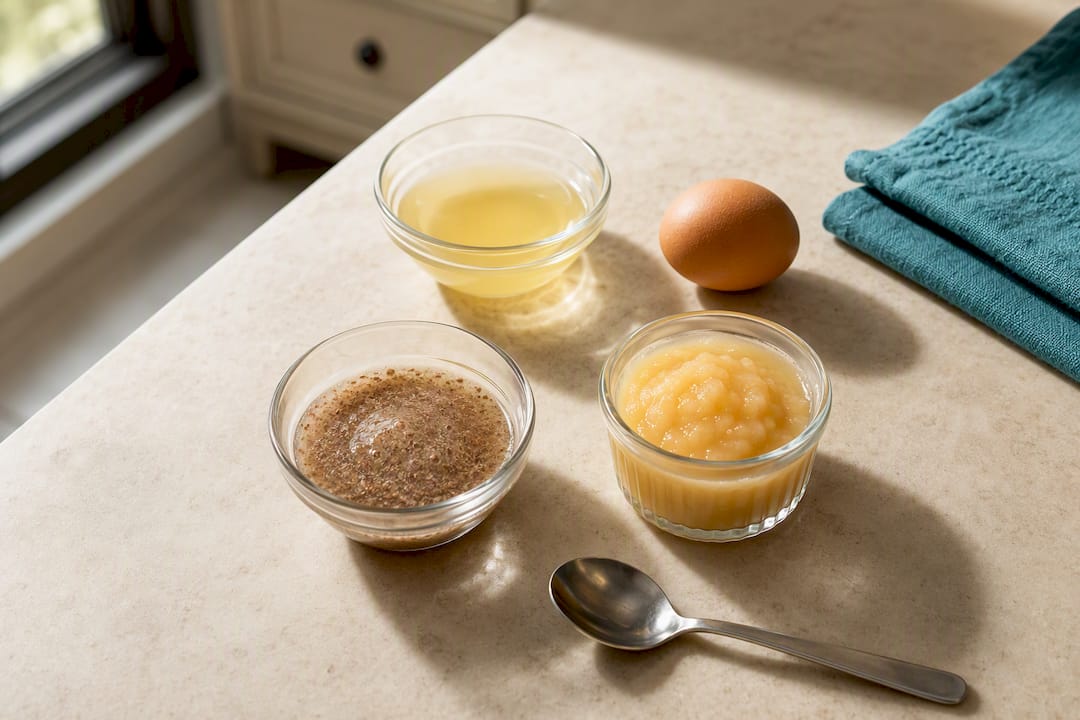
Eggs do three jobs depending on the recipe: binding, leavening, and moisture. For binding in dense bakes like brownies or quick breads, use about three tablespoons of aquafaba (the liquid from canned chickpeas) per egg, or mix one tablespoon ground flaxseed or chia with about three tablespoons water and let it gel for a few minutes. When an egg’s only job is moisture, a quarter cup of unsweetened applesauce or mashed banana works fine, though banana adds its own flavor.
Buttermilk is easy to fake for small amounts: 1 cup whole milk plus 1 tablespoon lemon juice or vinegar, rested for five minutes, according to Food Network’s substitution guide. Testing from Serious Eats found that kefir and plain yogurt thinned with a splash of milk actually beat the milk-and-acid trick for texture in cakes and biscuits, so reach for those when buttermilk is the star of the recipe rather than a minor player.
Flour swaps depend on protein content. Pastry flour can replace all-purpose in tender bakes; bread flour’s higher gluten helps chewy loaves but toughens cakes. For 1 teaspoon of baking powder, combine ¼ teaspoon baking soda with ½ teaspoon cream of tartar.
- Aquafaba: 3 Tbsp = 1 whole egg, best for binding and whipping into meringues
- Flax or chia egg: 1 Tbsp ground seed + 3 Tbsp water = 1 egg, best for moist, dense bakes
- Applesauce or banana: ¼ cup = 1 egg, moisture only, adds mild flavor
- Buttermilk substitute: 1 cup milk + 1 Tbsp lemon juice or vinegar, rested 5 minutes
Pro Tip: When a cake or biscuit recipe leans hard on buttermilk’s tang and thickness, skip the milk-and-acid shortcut and use plain yogurt or kefir thinned to a pourable consistency instead.
Flour and Grain Swaps: Bread, Cake, Oat, Almond, and Gluten-Free Blends
Not all flours behave the same, and volume-for-volume swaps only work within similar protein and starch profiles. Oat flour and almond flour absorb more liquid than all-purpose flour, so recipes using them often need extra egg or a touch more liquid to avoid dryness. Gluten-free blends usually need a binding agent like xanthan gum since they lack the gluten network that holds structure together.
- Cake flour for all-purpose: use ⅞ cupcake flour per 1 cup all-purpose, or add 2 Tbsp cornstarch to 1 cup all-purpose flour
- Bread flour for all-purpose: works fine cup-for-cup in most recipes, though bread rises chewier
- Almond or oat flour: replace up to 25% of all-purpose flour without major changes; beyond that, add a binder
- Gluten-free 1:1 blends: measure by weight, not volume, since density varies widely between brands
Weighing flour on a kitchen scale avoids the density mismatches that ruin gluten-free baking, since a cup of almond flour can weigh 30% more or less depending on how finely it’s ground.
Dairy and Dairy-Free Swaps for Milk, Cream, Butter, and Cheese
Plant milks vary enormously in thickness and fat content, which matters more in sauces than in coffee. Oat milk and full-fat coconut milk mimic dairy’s body reasonably well; almond milk runs thin and works better in pancake batter than in a béchamel. For cream in soups or sauces, evaporated milk delivers similar richness without the fat.
Butter converts to oil at roughly 1 cup butter to ¾ cup neutral oil in baking, though you lose the flavor and flakiness butter provides in pastry. For spreading on toast, that math doesn’t apply. Sour cream and plain yogurt swap evenly in most baked goods and dips; thin yogurt with a splash of milk if a recipe calls for sour cream’s pourable consistency.
- Milk: oat or coconut milk for body; almond milk for lighter batters
- Cream: evaporated milk in sauces and soups
- Butter to oil: 1 cup butter = ¾ cup neutral oil, best for muffins and quick breads
- Cheese: match by function, melty for pizza, spreadable for bagels, sharp for flavor punch
Sweetener Swaps: Sugar, Honey, Maple Syrup, and Brown Sugar
Liquid sweeteners like honey and maple syrup add moisture that granulated sugar doesn’t, so swapping introduces a liquid imbalance unless you compensate. The general rule: for every cup of honey or maple syrup replacing sugar, cut about 3 tablespoons of another liquid in the recipe and drop the oven temperature by 25 degrees Fahrenheit, since these syrups brown faster than dry sugar.
Brown sugar is easy to recreate: mix 1 cup granulated sugar with 1 tablespoon molasses for light brown, or 2 tablespoons for dark brown.
- Honey or maple syrup for sugar: use ¾ cup syrup per 1 cup sugar, reduce other liquid by 3 Tbsp, lower oven temp 25°F
- Brown sugar: 1 cup granulated sugar + 1 to 2 Tbsp molasses
- Low-calorie sweeteners: often lack sugar’s bulk, so cakes and cookies can turn out flatter or drier without added moisture
Thickener and Binder Swaps: Cornstarch, Arrowroot, Tapioca, and Gums
For thickening sauces and gravies, 1 tablespoon of cornstarch replaces 2 tablespoons of all-purpose flour, a ratio confirmed by Colorado State University Extension. Arrowroot makes a clearer, glossier sauce than cornstarch and holds up better through freezing and thawing, though cornstarch tolerates higher, longer cooking without breaking down.
Xanthan gum and guar gum work in tiny amounts, typically ¼ to ½ teaspoon per cup of liquid, so measure carefully rather than eyeballing.
- Cornstarch: 1 Tbsp = 2 Tbsp all-purpose flour for thickening
- Arrowroot: clearer finish, freezer-stable, best for delicate sauces and fruit fillings
- Tapioca starch: similar thickening power to cornstarch, holds up well in fruit pies
- Xanthan or guar gum: ¼ to ½ tsp per cup of liquid; too much turns sauces gluey
Extension research notes that arrowroot’s clarity and freeze-thaw stability make it the better choice for pie fillings meant to be frozen, while cornstarch handles the higher heat of a simmering gravy without issue.
Oil and Fat Swaps for Frying, Roasting, and Baking
Neutral oils like canola, vegetable, and sunflower swap interchangeably for frying and salad dressings since none carries a dominant flavor. Olive oil works in dressings and sautéing but can turn bitter at high frying temperatures, so save it for finishing rather than deep-frying.
For baking, 1 cup of solid butter converts to about ¾ cup of neutral oil, though the result loses butter’s flaky texture in pastry and biscuits.
- Frying and dressings: canola, vegetable, or sunflower oil, interchangeable
- Butter to oil in baking: 1 cup butter = ¾ cup oil, works best in muffins and cakes
- Strong-flavored oils: sesame or extra-virgin olive oil can overpower delicate baked goods; use only where the recipe wants that flavor
Herb, Spice, and Acid Swaps for Flavor and Marinades
Allspice tastes like a blend of cinnamon, cloves, and nutmeg, so combining equal parts of those three in a pinch gets you close. Pumpkin pie spice follows a similar logic: mix cinnamon, ginger, nutmeg, and cloves in roughly a 4:2:1:1 ratio if the jar is empty.
For acids, white wine vinegar and lemon juice swap evenly in most dressings, though lemon brings brightness while vinegar brings sharper tang, so pick based on which suits the dish. Dried herbs are more concentrated than fresh, so use one-third the amount of dried when a recipe calls for fresh, and add dried herbs earlier in cooking to let them rehydrate and release flavor.
- Allspice: equal parts cinnamon, cloves, nutmeg
- Pumpkin pie spice: cinnamon, ginger, nutmeg, cloves (roughly 4:2:1:1)
- Vinegar for lemon juice: swap evenly, but expect sharper tang instead of citrus brightness
- Dried for fresh herbs: use one-third the volume, add earlier in cooking
Protein Swaps: Meat, Seafood, and Plant-Based Options
Firm white fish like cod and halibut swap for one another with little change in cook time, but swapping a firm fish for a flaky one like tilapia means shortening cooking time to avoid overcooking. Ground turkey substitutes for ground beef in most recipes, though turkey’s lower fat content means adding a tablespoon of oil to prevent dryness.
Plant-based swaps rely on texture matching rather than flavor matching, since tofu and tempeh take on whatever seasoning surrounds them. Shredded jackfruit mimics pulled pork’s texture in barbecue dishes; tempeh’s firm bite works well diced into stir-fries or crumbled into taco filling.
- Firm fish for flaky fish: reduce cook time by two to three minutes to avoid drying out
- Ground turkey for beef: add 1 Tbsp oil per pound to offset lower fat content
- Jackfruit for pulled pork: shred and season heavily since jackfruit itself is mild
- Tofu or tempeh: press tofu to remove moisture before marinating for better flavor absorption
Whenever you substitute raw protein for another raw protein, verify internal temperature with a thermometer rather than relying on the original recipe’s timing, since cut thickness and moisture content change how fast heat penetrates.
Measurement Equivalents and Quick Ratio Cheats
Keep this table handy for the swaps that come up most often in daily cooking and baking.
| Original Ingredient | Substitute | Ratio |
|---|---|---|
| Buttermilk | Milk + acid | 1 cup buttermilk = 1 cup milk + 1 Tbsp lemon juice or vinegar |
| Baking powder | Baking soda + cream of tartar | 1 tsp baking powder = ¼ tsp baking soda + ½ tsp cream of tartar |
| All-purpose flour (thickening) | Cornstarch | 1 Tbsp cornstarch = 2 Tbsp all-purpose flour |
| Butter | Neutral oil | 1 cup butter = ¾ cup oil |
| Granulated sugar | Brown sugar | 1 cup granulated sugar + 1 to 2 Tbsp molasses = 1 cup brown sugar |
| Sour cream | Plain yogurt | 1:1 swap |
| Fresh herbs | Dried herbs | 1 Tbsp fresh = 1 tsp dried |
Legend: Tbsp = tablespoon, tsp = teaspoon. Densities vary by ingredient brand and grind, so treat these ratios as reliable starting points rather than absolutes, especially with flours and gluten-free blends.
When Substitutions Fail: Diagnosing Texture and Flavor Problems
A dense, gummy loaf usually means too much liquid entered the batter, often from a swap like applesauce or yogurt that wasn’t accounted for elsewhere. A flat cake that never rose points to a leavening miscalculation, commonly from skipping the cream-of-tartar step when making baking powder from scratch.
- Dense or gummy texture: reduce added liquid next time by 2 tablespoons and check that your leavener is fresh
- Flat rise: increase baking powder or soda slightly, or verify the substitute leavener was mixed correctly
- Tough or rubbery result: overmixing after a flour swap develops too much gluten; fold batter more gently
- Recipe never comes together: some high-structure recipes, like soufflés or angel food cake, don’t tolerate multiple substitutions at once
N.C. Cooperative Extension notes that egg substitutes reliably work for one or two eggs but frequently fail in recipes calling for four or more, where eggs provide essential structure rather than just moisture. When a recipe leans that heavily on one ingredient, it’s often faster to pick a different recipe than to force a workaround.
Pro Tip: Before troubleshooting a failed bake, ask whether the substitute changed the total liquid volume. Most texture problems trace back to liquid, not flavor.
Getting the Math Right: Converters That Save a Recipe
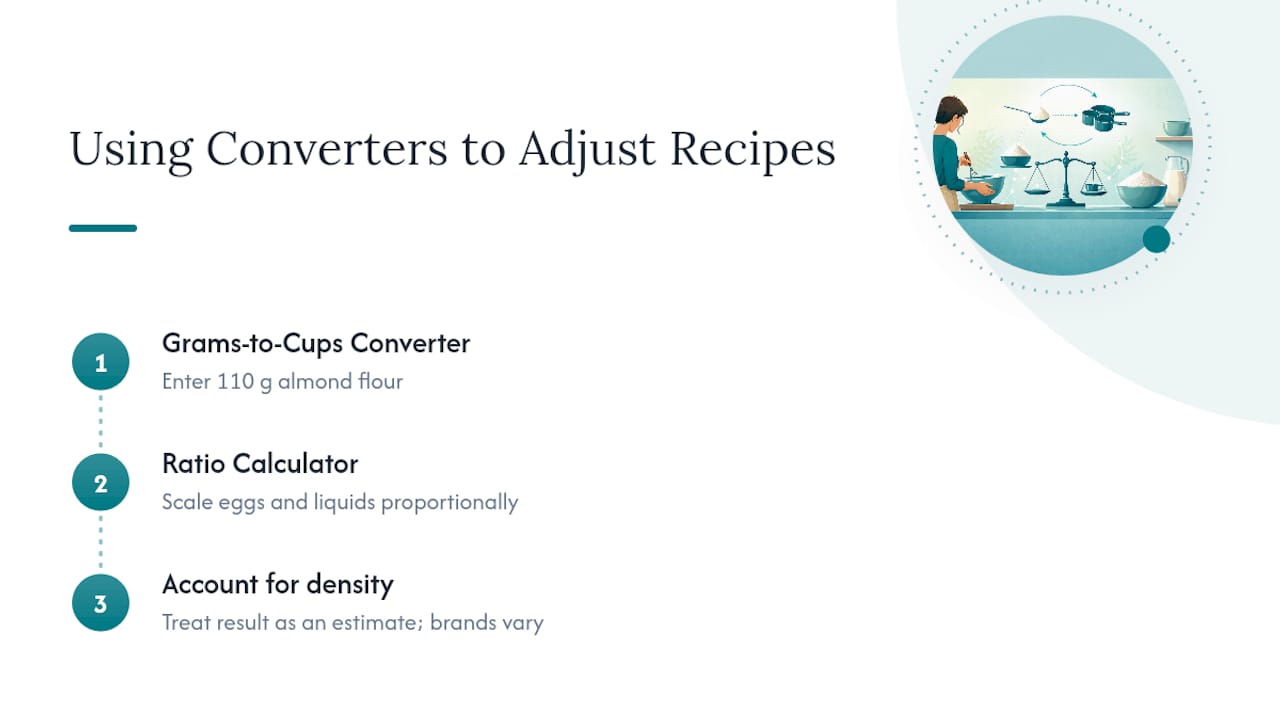
Substitution ratios only help if your measurements are accurate, and that’s where a couple of calculators earn their keep. The Grams to Cups Converter handles ingredient-specific weight-to-volume conversions, which matters because a cup of almond flour and a cup of bread flour weigh noticeably different amounts.
Say a recipe calls for 110 grams of almond flour but your measuring cups only show volume. Punch 110 grams of almond flour into the converter to get the cup equivalent, then use the Ratio Calculator to scale the rest of the recipe proportionally if you’re adjusting egg count or liquid to match that flour’s higher absorbency. Both tools run directly in your browser with no account required, though keep in mind that density varies by brand, so treat the conversion as a close estimate rather than an exact figure.
Substituting Common Allergens: Nuts, Gluten, and Soy
Nut-based ingredients usually serve a textural or fat role, which makes seed-based swaps the most reliable option. Sunflower seed butter replaces peanut or almond butter at a 1:1 ratio in most baked goods, though it can turn baked goods slightly green from a chemical reaction with baking soda, a harmless but surprising cosmetic effect. For chopped nuts in a crumble topping, toasted pumpkin seeds or crushed pretzels bring back the crunch without the allergen.
Gluten-free substitution is trickier because gluten provides structure that no single ingredient replicates alone. Commercial 1:1 gluten-free flour blends, which combine rice flour, starches, and xanthan gum, come closest to a straightforward swap in cookies and quick breads. Yeasted bread is harder to replicate since gluten’s stretch is what traps rising gas; expect a denser crumb even with a good blend.
Soy shows up hidden in soy sauce, tofu, edamame, and many processed foods, so read labels closely rather than assuming a recipe is soy-free just because it doesn’t list tofu. Coconut aminos replace soy sauce at a slightly sweeter 1:1 ratio, and chickpea flour tofu (sometimes called besan tofu) mimics regular tofu’s texture in stir-fries without soy.
Cross-contamination is a real concern for anyone with a diagnosed allergy rather than a preference, so check labels on shared-facility warnings rather than relying on ingredient lists alone.
Vegetable and Legume Substitutes That Actually Work
Vegetables swap most successfully when you match cook time and water content, not just flavor. Zucchini and yellow squash are nearly interchangeable in most savory dishes since both cook at similar speeds and carry mild flavor. Cauliflower rice replaces regular rice in stir-fries and bowls when you want fewer carbohydrates, though it releases more water during cooking, so drain it well or reduce added liquid elsewhere in the dish.
Legumes swap based on size and starch content more than flavor. Black beans and pinto beans work interchangeably in chili and burritos. Lentils substitute for ground meat in tacos or bolognese when cooked down and seasoned heavily, since their texture breaks down similarly once simmered. Canned chickpeas can stand in for white beans in soups and salads at a 1:1 ratio by drained weight.
- Zucchini for yellow squash: 1:1, nearly identical cook time
- Cauliflower rice for rice: 1:1 by volume, drain excess water after cooking
- Black beans for pinto beans: 1:1, both work in chili and burritos
- Lentils for ground meat: cook down and season heavily for a similar mouthfeel in tacos or sauces
Root vegetables like sweet potato and butternut squash also swap well in soups and roasts, since both caramelize similarly and hold their shape at comparable oven temperatures.
Fresh Versus Dried: Seasonal Swaps That Don’t Ruin a Dish
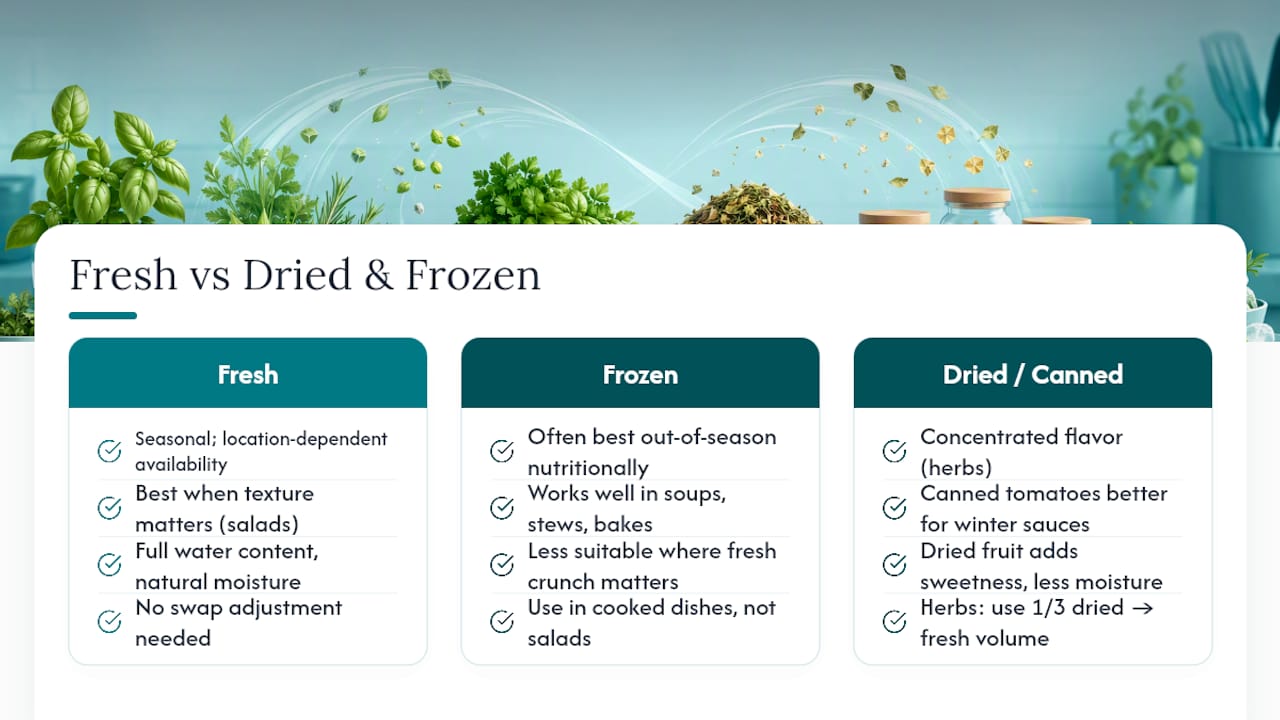
Fresh herbs and produce aren’t always available, and dried or frozen alternatives fill the gap differently depending on what the ingredient contributes. Dried herbs concentrate flavor as water evaporates, which is why the standard swap uses one-third the volume of dried herbs compared to fresh, as covered in the herbs and spices section above.
Frozen vegetables often outperform fresh ones out of season nutritionally, since they’re typically flash-frozen at peak ripeness rather than picked early for shipping. Frozen spinach, peas, and corn work well in soups, stews, and baked dishes where texture matters less than flavor. For dishes where fresh crunch matters, like a salad, frozen produce won’t substitute successfully regardless of season.
Canned tomatoes are often a better choice than fresh tomatoes for sauces during winter months, when fresh tomatoes are picked underripe and shipped long distances, losing flavor along the way. Dried fruit like cranberries or apricots can replace fresh fruit in baked goods, but they add concentrated sweetness and less moisture, so a recipe may need slightly more liquid to compensate.
Seasonal produce swaps also depend on regional availability rather than a universal calendar, so what’s fresh and cheap varies by where you’re shopping and when.
Keeping Nutritional Value Intact When You Swap Ingredients
Substituting for convenience or allergies doesn’t have to mean sacrificing nutrition, but it does require checking what the original ingredient contributed beyond flavor. Replacing white rice with quinoa or brown rice adds fiber and protein while keeping a similar texture in bowls and side dishes. Swapping sour cream for plain Greek yogurt in dips and baked goods cuts fat while adding protein, a trade that works in nearly every recipe that calls for sour cream’s tang.
Be cautious with sweetener swaps marketed as “healthier,” since honey and maple syrup carry similar calorie density to granulated sugar despite trace mineral content; the nutritional difference is minor compared to portion size. Whole wheat flour replacing all-purpose flour in a 1:1 ratio adds fiber, though it also adds density, so blending half whole wheat and half all-purpose often preserves both nutrition and texture better than a full swap.
When substituting to remove fat, like using applesauce instead of oil in a muffin recipe, understand that fat also carries flavor and moisture, so the result trades richness for lower calories, not an improvement across every metric. Nutritional value is rarely a straight upgrade or downgrade. It shifts depending on what the substitute adds and what it leaves out.
Cooking Substitutions Versus Baking Substitutions: Why the Rules Differ
Stovetop cooking forgives substitution mistakes that baking won’t. A soup, stir-fry, or sauce can absorb a swapped vegetable, a different acid, or a protein change with minimal risk, since heat and seasoning adjust in real time as you taste and correct.
Baking is a different discipline because it relies on chemical reactions that happen once and can’t be corrected mid-process. Flour provides structure through gluten development, eggs provide both binding and lift, and leaveners like baking soda and baking powder create precise gas reactions that happen on a schedule tied to oven temperature. Swap too many of these at once, and the recipe’s chemistry falls apart before you can intervene. This is why recipe developers consistently emphasize identifying an ingredient’s function first, especially before touching a cake, bread, or pastry recipe.
The practical takeaway: experiment freely with soups, stir-fries, and sauces, where a substitution that doesn’t work just means adjusting seasoning at the end. Approach baking recipes one substitution at a time, and lean on tested ratios like the ones in this list rather than guessing, since baking rarely offers a second chance to fix a batter that’s already in the oven.
GizmoBench Tools: Quick Helpers for Getting Substitutions Right
Substitution math gets easier with the right calculator on hand, and GizmoBench builds browser-based tools that need no account and no software install. The Grams to Cups Converter handles the weight-to-volume conversions that trip up gluten-free and specialty-flour baking, while the Ratio Calculator scales an entire recipe proportionally once you’ve adjusted one ingredient. Core functions on both tools are free to use.
Density still varies by ingredient brand and how finely something is milled, so treat any converted figure as a strong estimate rather than a lab-certified number. For everything else, from converting an odd European measurement to double-checking a percentage adjustment on a sugar swap, the full GizmoBench catalog covers calculators built for exactly this kind of kitchen math. Open the tool, plug in your numbers, and get back to cooking instead of doing conversions by hand.
Sources
This guide draws on tested substitution data rather than guesswork. Colorado State University Extension supplies lab-tested equivalence tables; Serious Eats ran side-by-side buttermilk substitute tests; NYT Cooking and Food Network bring recipe-developer expertise across categories; and N.C. Cooperative Extension addresses egg-substitute limits in structural baking.
- Ingredient Substitution Guide | Food Network
- Do Buttermilk Substitutes Work In Baking? | Serious Eats
- Ingredient substitutions | Colorado State University Extension
- Baking with egg substitutes | Brunswick County Center
FAQ
What’s a good substitution for eggs in baking?
For binding in dense bakes, use 3 tablespoons of aquafaba or 1 tablespoon ground flaxseed mixed with 3 tablespoons water per egg. These work best replacing one or two eggs; recipes calling for four or more eggs often fail because eggs provide structural lift that substitutes can’t replicate at that scale.
What are some healthy substitutes I can use in recipes?
Plain Greek yogurt for sour cream cuts fat while adding protein, and quinoa or brown rice in place of white rice adds fiber without changing texture much. Nutritional swaps rarely improve every metric at once, so weigh what you’re gaining against what the original ingredient contributed in flavor or moisture.
What can I use as a substitute for baking ingredients like buttermilk or baking powder?
For buttermilk, mix 1 cup milk with 1 tablespoon lemon juice or vinegar and let it rest five minutes, though kefir or plain yogurt often performs better in recipes where buttermilk is the dominant flavor. For baking powder, combine ¼ teaspoon baking soda with ½ teaspoon cream of tartar per teaspoon needed.
Can you give me an example of a food substitution?
A common one: 1 tablespoon of cornstarch replaces 2 tablespoons of all-purpose flour for thickening sauces and gravies, a ratio confirmed by Colorado State University Extension. Another everyday swap is using ¾ cup neutral oil in place of 1 cup butter in muffins or quick breads, though you lose butter’s flavor and flakiness.
How do I calculate the right amount when converting a substitution ratio?
Start with the ratio for your specific ingredient, then use a tool like the Grams to Cups Converter to handle weight-to-volume differences, since flours and sugars vary in density. The Ratio Calculator helps scale the rest of the recipe proportionally once you’ve made one substitution.